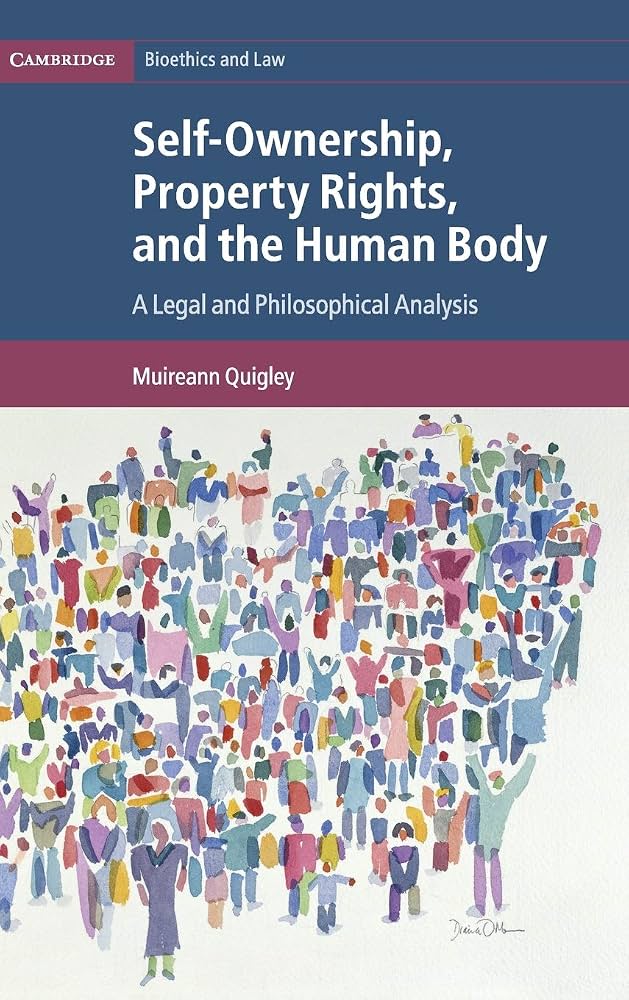
SELF-OWNERSHIP
Pubblicato da : res publica : quaderni europei: ottobre 2026
Introduction
The term self-ownership refers to a cultural movement that places individual freedom above all else.
The English term literally means ownership of oneself, but in this context it is translated as self-belonging, a term that is rarely used in Italy.
It is a school of thought according to which every individual has complete ownership of their own body, mind and talents and therefore has the right to self-determination: neither the State nor society has the right to use, control or dispose of a person's body or life without their consent. The individual is therefore the master of their own choices and of the fruits of their labour.
In reality, the movement has many different variations and is, in some ways, also transversal to both the political right and the left, which is not something we need to examine here: we will limit ourselves to its general principles.
It seems to us that no society, either past or present, has ever implemented such a principle, and certainly not because of human wickedness, but because it is simply inapplicable. It therefore remains one of the many utopias (= nowhere) that have characterised the history of human thought.
They seem to us to be fantasies that have never been realised because they are impossible to realise, and therefore we are talking about something that does not exist in reality.
Indeed, freedom of choice is always exercised within the sphere in which there are NO prohibitions or social obligations and, above all, within the realm of what is possible.
In reality, neither freedom nor the absence of freedom exists in absolute terms. All social organisations have rules establishing what one MUST do and what one MUST NOT do. Individual freedom is always exercised within the areas that are not regulated by society, which are relatively few. This applies to every civilisation, culture, political regime and social structure: what changes are the rules and the scope of their application. It makes no difference whether we are talking about a democracy, a dictatorship, a theocracy or an absolute monarchy.
When we speak of freedom in a democracy, we mean that everyone is free to express their opinions and that majority opinions prevail, certainly not that everyone can do whatever they want. There is no sphere of activity that is entirely beyond restriction, except that which society itself defines as such.
Let us take an example: we say that in the West women are free to dress as they wish, whereas in the Muslim world they are not.
But this is not the case: women can wear a bikini, but NOT to the office; in certain jobs, moreover, they must wear uniforms. In theory, they could also dress in Muslim clothing, but in practice they must follow fashion and social conventions. They cannot attend a wedding dressed in white, since white is reserved for the bride, once a symbol of virginity. In this regard, we should note that in the past women had to preserve their virginity if they wanted to get married, whereas today, if they want to find a husband, they must give up their virginity beforehand.
Everywhere in society, we find rules and hierarchies; otherwise, organisations would not function.
One might think that freedom, in the sense of self-ownership, would be possible only on an uninhabited atoll, as in the case of Robinson Crusoe. But this is not really so, because in such a situation one would certainly not have much choice, since every action would be dictated by the need to survive.
On the contrary, it is in a well-ordered and well-organised society, in which rules are followed, that people enjoy well-being and security and, consequently, the sphere of freedom can expand. Indeed, the more prosperous countries tend to offer greater freedom.
The idea, moreover, that the family is a private sphere into which society cannot intrude and in which there are therefore no rules is absurd. Within a couple, one must constantly take the needs of one's spouse into account, and, above all, the care and upbringing of children affect every moment of our lives. We cannot even sleep when they are newborns.
Of course, one can also choose not to marry and not to have children, but this runs counter to our nature and makes us sad and unhappy.
Actions Affecting Others
In discussions of self-ownership, the limits of individual action are sometimes defined by distinguishing between actions that affect others and those that concern only the person performing them. In practice, however, this distinction does not exist, because every action always has an impact on others, except perhaps for a few insignificant matters.
For example, it might seem that if I smoke, it concerns only me.
But, leaving aside the burden on the healthcare system, the dramatic impact may be on one's own family, on one's role as a husband or father, or perhaps as a son, potentially destroying one's parents' lives. Taking care of one's health is a moral duty.
Even if I drink champagne instead of sparkling wine, I harm the national economy. In reality, there are no actions that do not have repercussions for others, except perhaps for a few truly insignificant ones.
Another essential point is that self-ownership essentially regards authority as a limitation on freedom.
But the question is whether authority subordinates others or places itself at their service. There is a difference between having authority over slaves, understood as "animated tools", as Aristotle called them, and having authority over children in order to protect them and guide them towards what is good.
Indeed, in our civilisation, the meaning of servus has been reversed: the Pope called himself servus servorum (servant of the servants), monarchs considered themselves servants of their subjects, and so on.
The question, then, is whether those who govern serve those who are governed or the other way around. In the first case, authority is legitimate; in the second, it is not. The authority of men within the family, for example, derived from the different roles once assigned to men and women, not from the idea that authority should not exist. Indeed, marital authority has disappeared, but parental authority has not.
It is obvious that parents can make mistakes, but it is equally obvious that they do what they believe to be in the best interests of their children. Outside REALITY, however, it would be as though children could dismiss their parents and appoint others in their place. Clearly, in reality, if it becomes necessary to protect children from parents who are mentally disturbed or incapable, society intervenes, as it always does, according to the principles that guide it.
As I have said, social rules also apply within the family.
Written Laws and Practical Limitations
We should also bear in mind that we are not dealing only with laws written by the State; in fact, the most important and pervasive rules are unwritten.
The social rules that truly affect individuals are certainly not written laws (such as the criminal code), which concern relatively marginal cases, are violated by only a few people and, when they are violated, usually involve very particular circumstances. The most important and intrusive rules are unwritten ones. For example, as we have said, a young woman must observe the rules of sexual morality if she wants to find a husband. Sanctions do not concern only criminal offences; social sanctions may perhaps be even more severe.
Even with regard to freedom of contract, on which self-ownership places considerable emphasis as an expression of freedom, we need to be clear about what we mean.
Accepting certain conditions does not always constitute a free choice. It is not as though I can refuse a job simply because the employer imposes something I do not like. Nor is a poor immigrant truly free to decide whether or not to pick tomatoes under the scorching sun for very little money. Employment choices are limited, sometimes extremely so, and we therefore have to accept even things that we detest.
Indeed, the State establishes minimum conditions, social security contributions, holidays, and so on, and we must also comply with State laws, in addition to the principle of supply and demand. Therefore, even if we have freely chosen a job, it is not true that we can subsequently choose not to do it. It is also said that true freedom is freedom from need.
Similarly, when we choose a spouse, we cannot simply choose whomever we want, but only from within a limited range of possibilities. Sometimes we have to settle for the only person who has said yes to us.
If a person does not work because they do not want to, they cannot survive; if they are too demanding in choosing a spouse, they risk never getting married, and so on. These are not sanctions imposed by law, but they are nevertheless very serious sanctions.
In general, social approval and respect are also extremely important factors for everyone: we are social animals.
Bearing in mind that reality imposes many additional and stronger constraints, we realise that our freedom is increasingly restricted. For example, I would like to travel, but I do not have the money, or I would like to eat a cake, but I have diabetes.
Conclusions
The discussion of self-ownership brings to mind the idea that society and the State originated from a social contract, an idea that dates back to the eighteenth century but that has never been put into practice because it is impossible to realise.
The fundamental mistake is to set the individual against society, as though they were two separate and unrelated entities. But THAT IS NOT THE CASE.
I am who I am because I live in the twenty-first century in the West. If I lived in the Muslim world or in the West several centuries ago, I would be a different person.
It is not that women in the past were virgins on their wedding day merely because they were forced to conform to customs, but because they themselves believed that this was what they called honour and, without it, they felt disgraced and unworthy of being wives and mothers.
If Roman mothers handed their sons their shields, telling them, "With this or on this" (that is, better to die than to flee), it was not simply because this was the law, but because they genuinely believed in it, and so on.
Individuals live within a particular cultural context that they share with others. If women in the past devoted themselves exclusively to their families and homes, this was not merely an imposition, but also a conviction of their own.
Society cannot be founded on self-interest, which is precisely what causes society to disintegrate, but rather on a sense of solidarity and the sharing of ideals.
The discussion of society always concerns human nature: by nature, we live in families; we need to share our lives and intimacy with a spouse; we need children to whom we can devote our lives, and later, even more dearly loved grandchildren.
Many philosophers therefore argue that true freedom consists in following moral laws, because only in this way can human beings fulfil themselves, which would constitute true freedom.
Kant said: "Two things fill the mind with ever-increasing admiration and awe: the starry heavens above me and the moral law within me."
In a democracy, there is the possibility (or rather, a greater possibility) of identifying alternatives and, consequently, adopting them if we so choose. This is the meaning of freedom of expression and universal suffrage.
Perhaps this is why the most advanced and prosperous countries are democratic.
However, democracy is possible only in countries whose culture accepts and supports it: culture (mentality) is stronger than institutions.
For this reason, it is necessary to counter the fantasies of self-ownership with real democracy, which I consider the best system implemented so far, in which freedom is exercised only within the sphere that social rules regard as neither prohibited nor mandatory.
Society should be judged on the basis of its ability to fulfil our human nature.