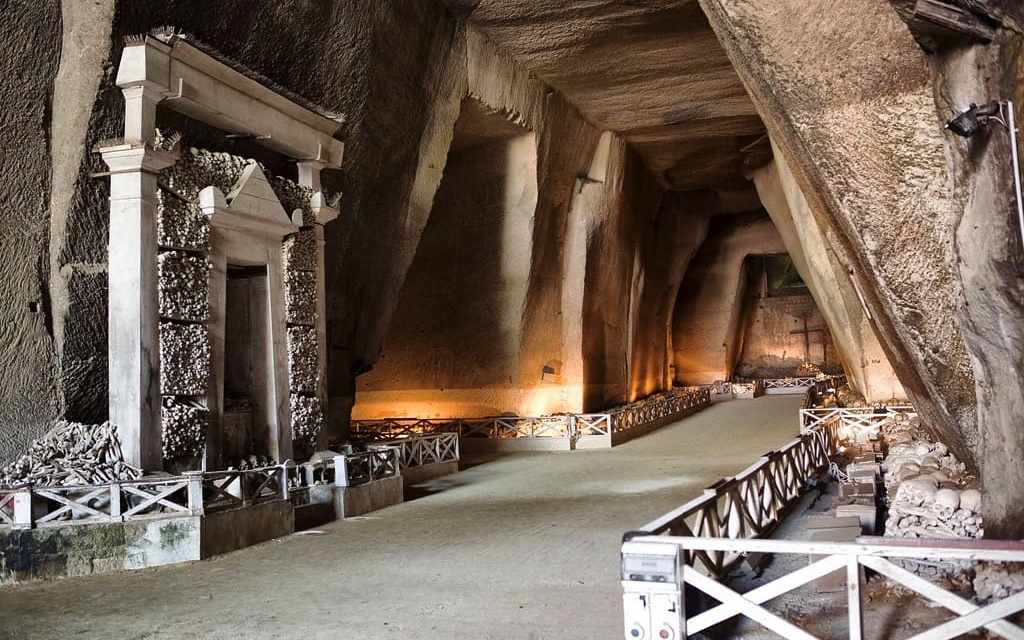
At the Fontanelle Cemetery
The Fontanelle Cemetery in Naples was recently reopened to the public. It is a quarry—or, more precisely, a series of tuff quarries—in which, in past centuries, the mortal remains of Neapolitans who had died, generally, though not exclusively, as a result of epidemics were buried, up until the nineteenth century.
Later, the cult of the anime pezzentelle spread there, that is, the cult of the souls who were petentes (that is, those who ask) for prayers and intercession. A distinctly Neapolitan custom thus developed, whereby the faithful would adopt the skull of a deceased person. They would often build a small box for it, something like a little shrine, and ask the unknown deceased person to pray for their own needs; in return, they would pray for that person's soul in purgatory.
The very knowledgeable guides tell visitors that the faithful would sometimes even dream of the souls they had adopted, and they recount the many legends that arose around them: the Captain, Donna Concetta, 'o Monaco, the Tribunal, the priests, and many others.
Yet it seems to us that, fascinating and engaging though these legends undoubtedly are, they fail to grasp the true, deeper meaning of this quarry and of other similar places.
This form of worship is, in fact, the spontaneous and naïve result of the relationship between the living and the dead as proposed by Christianity. Those who are no longer alive continue to exist for eternity, that is, outside time. According to the doctrine of the communion of saints, it is possible to pray for the dead, and they can pray for the living.
Thus, someone who has lost a loved one—a parent, a child, a spouse—can still turn to that person, speak to them, confide in them; they can help them on their journey towards God in the afterlife (purgatory), while the deceased can, in some way, watch over, protect, and help the living by praying to God. There is, in other words, a continuity between life and death, between those who have passed through the door of death and those who are still on this side of it, waiting to cross it.
This way of thinking is gradually fading and disappearing in our world today. In the modern world, death is hidden from children, whereas in the past they took part in the mourning of the family. Thus, people grow up without an awareness of death, whereas children in earlier times learned about it from their earliest years.
We might also say that, once upon a time, death was present in the world at every turn: many, many children died, as did many women in childbirth. No one could be entirely sure, when going to bed, that they would wake up the next morning; indeed, there was a specific prayer to be recited before going to sleep.
Today, death mainly concerns elderly people, grandparents, who already have relatively little life left ahead of them, whereas in the past death was constantly present among the living.
Today, people often die in hospitals, in remote and isolated places where others cannot enter, whereas in the past one would bid farewell to life surrounded by one's loved ones.
The custom at the Fontanelle was later opposed by the Church because, in effect, it had become an exchange of favors, with a pagan-like character. It was what was expressed in Latin as do ut des (“I give to you so that you may give to me”), whereas a Christian's prayer for another person should be motivated by caritas (the agape of the Greek), that is, by selfless love, which is the first commandment of Christianity.
As St. Paul wrote:
“If I speak in the tongues of men and of angels, but do not have charity, I am like a resounding gong or a clanging cymbal. And if I give away all my possessions and give my body to be burned, but do not have charity, I gain nothing.”