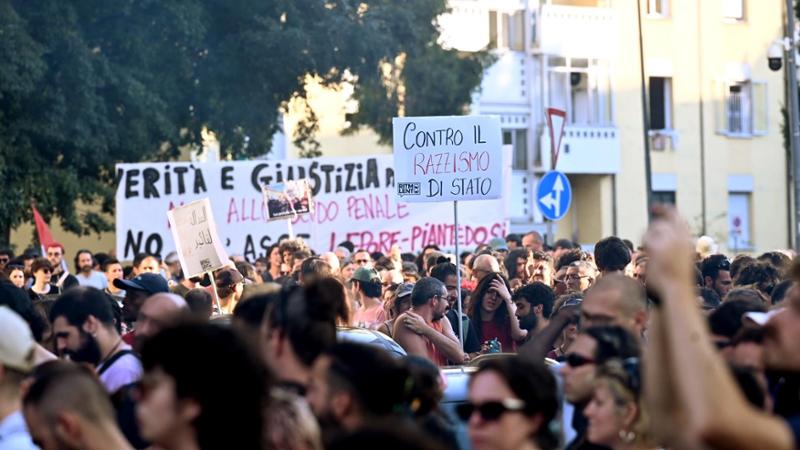
It has happened, as often happens, that certain judicial cases have sparked fierce political controversy between the political right and the political left. In reality, however, these are merely pretexts because, if we examine the facts objectively, they have little or nothing to do with political debates or ideological positions.
We are referring to the judicial cases of Roggero and Abderrahim Fakir, a Tunisian immigrant.
In the first case, a jeweler, Roggero, several years ago killed two robbers and wounded a third after they had already fled his jewelry store. He chased them and deliberately killed them. He was sentenced to 16 years in prison and was also ordered to pay €400,000 in damages.
The ruling caused a public outcry and divided public opinion. Many saw it as a reversal of justice: the victim of a robbery being convicted (some say effectively sentenced to life imprisonment, given that the defendant is over 72 years old), while the robbers' families receive compensation. Consequently, the political right has strongly criticized the ruling and, although it is not stated explicitly, implies that the judges are politically left-wing and therefore, for ideological reasons, punish those who defend themselves instead of protecting law and order and the victims of crime.
On the other hand, the political left does not question the judges' decision and instead accuses the right of wanting to replace the rule of law with the use of force, of trying to create a "Wild West" in our country where everyone takes justice into their own hands, of undermining constitutional principles and, as usually happens, of being fascist.
However, if we examine the issue objectively, both positions appear exaggerated, only loosely connected to the actual facts, and merely serve as pretexts for launching a long electoral campaign leading up to the 2027 elections.
In fact, it is difficult to see how the judges could have ruled differently. The law is clear, and indeed, at all three levels of the judicial process, the ruling was essentially the same. This was not a case of self-defense because there was no longer any danger to Roggero or his family's safety. The robbery was already over, and pursuing and deliberately killing the robbers is not permitted under Italian law. In applying that law, the judges had little choice. They also took proper account of the defendant's state of extreme stress by imposing the minimum sentence.
Of course, one may believe that the jeweler's actions were morally justified by the circumstances. The point, however, is that the judiciary must—or at least should—apply the law rather than what it personally considers to be just.
It is worth noting that there is some linguistic confusion. In court we speak of "justice," whereas what is actually being administered is legality. Judges rule according to the law, which may itself be considered unjust; nevertheless, until the law is changed, the judiciary is required to apply it.
A request for a presidential pardon was made hastily to the President of the Republic, triggering further controversy. However, a pardon is not a fourth level of judicial review, nor does it overturn court rulings. For humanitarian reasons, the President of the Republic may grant a pardon, but this requires a long and complex procedure. In practice, it may reduce a sentence but cannot erase it altogether.
One might therefore consider changing the law. No changes are currently being proposed regarding presidential pardons. The concept of self-defense could be broadened to include situations where there is no longer any immediate danger; however, such proposals are clearly inconceivable. The very foundation of the State—indeed of any State—is that it alone is responsible for punishing criminal offenses. Under no circumstances can private justice be accepted. This is a universal principle found in every legal system and is, one might say, one of the very foundations of the State. It has also been suggested that compensation should be abolished for those who suffer damage as a consequence of a criminal act. This too seems unrealistic to me. If an offense has been committed—and taking justice into one's own hands is itself a criminal offense—why should compensation not also be awarded?
This is not a matter of being right-wing or left-wing, nor of being for or against the judiciary, but of objectively assessable facts, regardless of one's political orientation.
The second case concerns Abderrahim Fakir, a man of Tunisian origin. While suffering a severe nervous breakdown, he was stopped and restrained by police officers and subsequently died. We have numerous videos of what happened, but we still do not know the true cause of death. It may have been the result of excessive force used by the officers while restraining him, or it may have been due to other causes. It will take some time for the medical examinations to establish this with certainty.
Until those examinations have been completed and evaluated, we cannot know whether the officers bear any responsibility. Yet here too the usual left-right political controversy has erupted. The political right declares itself confident that the police acted appropriately and accuses the left, as usual, of undermining public confidence in the police and, consequently, public safety.
The political left, on the other hand, appears to question the impartiality of the investigation. It implies that the police used excessive violence and ultimately resorts to the familiar accusation of fascism.
Indeed, a group of protesters attacked the police, causing disorder, injuries, and property damage.
In reality, these facts have little to do with such political disputes. The police certainly had to intervene. We simply do not yet know whether they used excessive force or not; we will have to wait for the evidence.
In any event, if mistakes were made, they would concern the way the operation was conducted. The officers certainly neither intended nor foresaw the detainee's death. The judiciary will determine any responsibility and rule according to the circumstances.
Amid all the controversy, the most balanced voice has been that of the victim's sister, who has made it clear that she accuses no one and asks only for the truth. On that point, no one can reasonably disagree with her.
Using this tragedy as a pretext for political propaganda seems highly inappropriate.