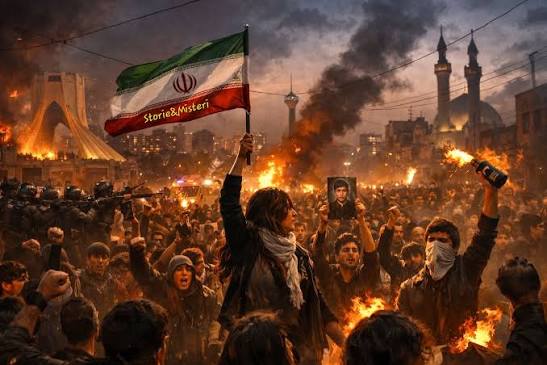
Collective Madness
Pubblicato da : res publica : quaderni europei: agosto 2026
We often speak of
collective madness when referring to ideologies, political movements, or
military interventions that we consider completely irrational.
But what does “collective madness” actually mean?
Madness, in the proper medical sense, is a pathology that affects individuals, certainly not societies. By extension, we call “collective madness” those ideologies that, from OUR point of view, seem mad to us.
Error is something different from madness: believing that Jews are evil by genetic nature is an error; believing that plants are persecuting me is madness.
One must also look at the purpose being pursued. If a person smashes a vase because he believes it is persecuting him, we think he is mad; but if he smashes a vase containing the relics of Saint Januarius because he belongs to an organization that wants to destroy the faith of the Neapolitans, then we say it is a political or ideological act.
It may be observed that even the madman always identifies a reason: the point is that one must above all consider the cultural context in which an action takes place.
Taking some historical examples: the Aztecs believed that, in order to strengthen the sun and ensure good harvests, it was necessary to perform human sacrifices on a large scale. This was not an isolated belief: the Carthaginians (Phoenicians) also had the tophet; in moments of danger they even offered their own children as sacrifices, and we find traces of similar practices in the Greek world as well (the sacrifice of Iphigenia) and even in the Bible (Abraham and Isaac). Were the Phoenicians and the Aztecs mad? Certainly not, but rather great civilizations.
But if a twenty-first-century Westerner thought of sacrificing a child in order to obtain a good harvest, he would certainly be considered insane.
An action can always be considered mad only in relation to the cultural context in which it occurs: therefore we may conclude that an action may or may not be mad depending on the cultural context in which it takes place. Performing a human sacrifice is not madness among the ancient Aztecs, but it is among us.
From this we may deduce that collective madness does not exist, but only cultures that we do not share and that we consider mistaken. But error is not madness and, above all, every civilization and every culture has its own values and convictions, which we may or may not share. We should not therefore think that those who hold ideas or beliefs different from ours are mad.
Let us apply this concept to the modern relationship we have with the Islamic world.
We think that Islamic fundamentalists, the Bin Ladens, the ayatollahs, are madmen of the Middle East, and we do not even realize that similar principles were also shared in the past by our own civilization.
It seems madness to us that a woman should have to cover her hair, as many Muslims believe, but it is enough to look around us and see nuns doing the same to remind ourselves that in reality this custom was once entirely common among us as well for all women, and that until a few generations ago women in church were required to cover their heads, as Saint Paul explicitly prescribed in a famous epistle.
Let us think of those who crashed into the Twin Towers: to us they had a mad ideology, but they were considered heroes in most of the Arab world.
So, were those Christians who allowed themselves to be killed in order to bear witness to their faith mad (martyrdom in Greek, shahada in Arabic)?
Fighting and dying for one’s homeland, justice, or faith has always been considered a heroic act: a Bin Laden holds this conviction and is consistent with it.
The fact that we do not share this conviction is another matter.
Were those who
massacred the Albigensian heretics mad?
And the knights who departed for the Crusades? Or even religious orders such as
the Templars, who combined monastic ideals with military ones?
Certainly not, even if these ideas have now disappeared among us: today even the Pope says, to the general approval of believers and non-believers alike, that no war can be considered willed by God; yet in the time of the Crusaders people said “Deus vult,” and masses of men were ready to die for it.
Here in Europe, religious freedom became established, and it was the first of freedoms and is even called the mother of all freedoms.
In the Middle East this principle did not become established, but there is tolerance for the “People of the Book” (Ahl al-Kitab).
In the past, Europe had no religious tolerance whatsoever: indeed, there are no longer Islamic communities in Europe (in Sicily and Spain), apart from migrants and a few modern converts, whereas there are Christian communities in the Middle East and, until 1948, there were also many Jewish ones.
In the West we have democracy and freedom (religious and otherwise); in the Middle East there is another civilization.
There is Islamic tolerance, which does not mean religious freedom, but only that the “People of the Book” may practice their religion provided they do not attempt to convert Muslims or attack them. There is also a law according to which, once converted to Islam, it is no longer permitted to return to one’s original religion.
Therefore, there is no religious freedom in the Middle East, but only tolerance toward Christians.
I should also recall that we ourselves have not always had religious freedom, and I am not referring only to past centuries: indeed, until not so long ago we experienced fascisms and communisms that admitted no freedom.
To us, obviously, our culture seems superior; to Muslims, theirs does, just as happened in the worlds of fascism and communism.
We should note that even religious freedom depends on points of view: I do not know whether it is more rational to believe in one religion and think all others false, or to believe that all religions should have equal dignity.
As was said at the Second Vatican Council, does truth have the same rights as falsehood?
Obviously, as a European, I support religious freedom because that is what I was taught from childhood, and it seems madness to me that someone should not be free to follow his own religion, or none at all.
Had I been born in Saudi Arabia, I would probably think that there is only one true religion.
A different issue, it seems to me, concerns crowds that commit what we call follies.
However, it does not seem to me that there is madness in outbreaks of crowd violence, but rather merely errors of judgment. For example, the crowds described in The Betrothed, who assault the bakeries, do foolish things only because they choose the wrong target (they blame poor Ferrer); it is not that they are mad.
The storming of the Bastille was likewise based on misinformation: there were no political prisoners there at all, yet it is not considered madness but rather the symbol of a new age of liberty and progress, and it is still celebrated with a great festival.
It is true, however, that crowds lose control. A crowd is not the sum of the individuals who compose it: each person feels justified and approved by all the others and therefore becomes irresponsible, doing things he certainly would not do alone. Thus lynchings occur, in which participants do things they would never do individually.
More simply, I would also say that when boys are together, they are much more likely to harass a girl than when they are alone.