The Meaning of Ashura for Shiites
Pubblicato da In dies Info 2026
Between June 24 and 25, Ashura was observed throughout the Islamic world, including by Muslim communities living in Italy.
Ashura literally means "the tenth," because it refers to the tenth day of the month of Muharram, according to the lunar calendar used by Muslims.
The observance originated as the commemoration of the day when God saved Moses (Musa in Arabic) by parting the waters of the Red Sea so that the Israelites could escape from Egypt. Over time, many other biblical events came to be associated with the same day: Noah landed after the Flood, God forgave Adam, Joseph was released from prison, Jesus, Abraham, and Adam were born, Muhammad was conceived, and many other events were likewise believed to have occurred on that same day.
It is generally assumed that the observance derives from the Jewish Yom Kippur (the Day of Atonement), which commemorates God's forgiveness of the Israelites after they had worshipped the Golden Calf while Moses was on Mount Sinai receiving God's Law, which Christians commonly refer to as the Ten Commandments.
The observance takes on different characteristics in the Sunni and Shiite worlds.
Sunnis constitute the overwhelming majority of Muslims. They follow the Sunnah (that is, tradition), which was codified over the centuries on the basis of the Qur'an and the Hadith (accounts concerning Muhammad), the Rasul ("Messenger"), whom we translate as "Prophet."
Among Sunnis, the observance generally has the character of a celebration. People fast (sawm), give alms (zakat), but they also celebrate. In a sense, it may be compared to a Christian feast such as the Feast of the Assumption. In North Africa, in particular, it has taken on a joyful character dedicated especially to children, who go from house to house wearing masks and asking for sweets, making it somewhat resemble our Carnival.
Among Shiites, however, the observance has acquired a very different meaning. Shiism originated from a dispute over succession (the caliphs in Arabic). After Muhammad's death, Abu Bakr (the father of Aisha, Muhammad's child bride) was chosen as caliph, but many considered Ali ibn Abi Talib to be the legitimate successor. These followers became known as Shiites, meaning "followers of Ali." One of Ali's descendants, al-Husayn, came into conflict with the reigning caliph and, in 680 A.D., at Karbala (present-day Iraq), he was defeated and killed together with nearly all his followers on the very day of Ashura: the tenth day of Muharram.
This event has taken on a far broader and deeper significance than a dynastic struggle that took place fourteen centuries ago. It has become the founding event of Shiism and is regarded as the symbol of the struggle between good and evil.
The death of Husayn and his followers came to be regarded as martyrdom: in Arabic, shahada, meaning the testimony of faith (which is also the original Greek meaning of the word "martyr").
Ashura is therefore not a celebration but rather a tragic and sorrowful observance. Crowds of believers travel to Karbala (Iraq) to commemorate Husayn's martyrdom. During Saddam Hussein's rule, violent clashes and massacres occurred almost every year, to the point that the observance was eventually banned for a period.
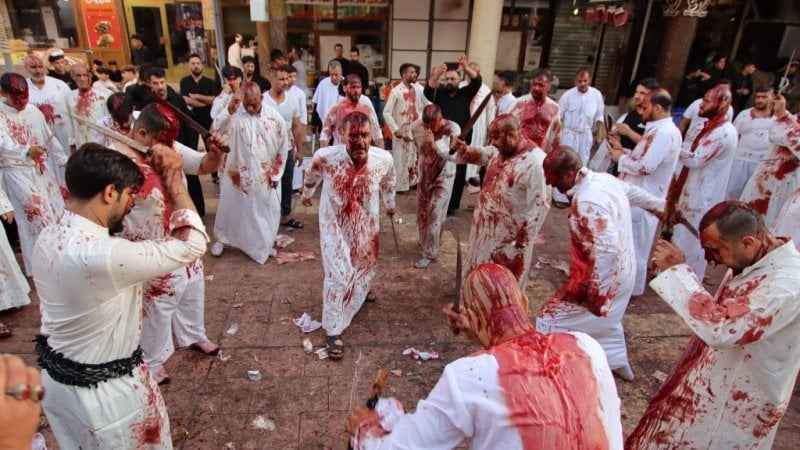
During Ashura, believers engage in self-flagellation; some even wound themselves with bladed weapons (although this practice has now been prohibited by religious authorities). Blood flows freely over their bodies.
One might compare this to Good Friday in the Christian tradition. In Italy, too, there were once the battenti, the self-flagellants; today they survive only as a folkloric tradition, the most famous being that of Guardia Sanframondi, in the province of Benevento.
There is, however, one fundamental difference. The self-flagellation practiced by our battenti, and more generally the painful forms of penance once common among Christians (such as the hairshirt worn in many places, even by Lucrezia Borgia in Ferrara), had a peaceful meaning, consistent with the example of the early Christian martyrs.
Shiite self-flagellation, by contrast, ultimately takes on an aggressive, warlike meaning. The underlying principle is that of jihad, which we incorrectly translate as "holy war." In reality, it means "struggle" or "effort" to conform oneself to divine law, namely the Sharia. Therefore, it may also be understood as an inner and peaceful struggle. However, unlike Christianity, it can also refer to warfare against unbelievers. The idea is that a man who dies in jihad as a shahid (martyr) immediately enters Paradise; men are rewarded there with the beautiful huris. For women, no corresponding reward involving men is described—that would be considered improper—nor for children; instead, they are promised vaguely defined delights that are not of a sexual nature.
Ashura therefore embodies a yearning for martyrdom through which the bliss of the Islamic paradise is attained.
To Westerners, this mentality appears highly dangerous. In effect, it creates large numbers of people who aspire to martyrdom in war. This means that they are never deterred by disasters or military defeats.
Indeed, if we look at recent events in the Middle East, we see that Iran has demonstrated that it is by no means capable of matching American and Israeli forces, whose military and technological superiority has proved overwhelming. Iran has suffered losses infinitely greater than those of its enemies; indeed, many of its highest-ranking commanders have been killed in remarkably precise and effective attacks. Trump repeatedly threatens to wipe Iran off the map—certainly an absurd exaggeration, like many of the things he says. Nevertheless, within a matter of days the United States could inflict devastating damage on Iran's economic and civilian infrastructure, damage that would require an entire generation to repair. Yet, despite these overwhelming defeats, many claim that Iran has won the war against the American superpower because they do not take account of the losses suffered. An Iranian killed in war against the "Great Satan" and the "Little Satan" (America and Israel) is regarded as a martyr to be emulated; he has borne witness to his faith in God and has entered Paradise to enjoy his eternal reward. By contrast, an American soldier killed in war is viewed as an unjustifiable tragedy, an irreparable loss for which the political authorities (in this case, Trump) bear responsibility.
Likewise, the Shiites of Lebanon call their militia Hezbollah ("Party of God") and continue to launch drones and missiles against northern Israel despite repeated setbacks, massacres, and destruction. They also oppose and demonstrate en masse against the ceasefire agreed upon by the Lebanese authorities and the Israelis.
This, ultimately, is the meaning implied by Ashura, one that we in the West find difficult to understand. Many people in Italy were scandalized by the separation of women and men during the observance, but few grasped its religious significance, which is far from reassuring.
On the other hand, Sunni fundamentalists also follow a broadly similar cultural model. Gaza has been devastated, its population is living in extreme anguish, yet Hamas remains firmly in power, supported by a population that continues to hope for victory and for the destruction of Israel, because victory and defeat are believed to depend not on the balance of military forces but on the will of God.