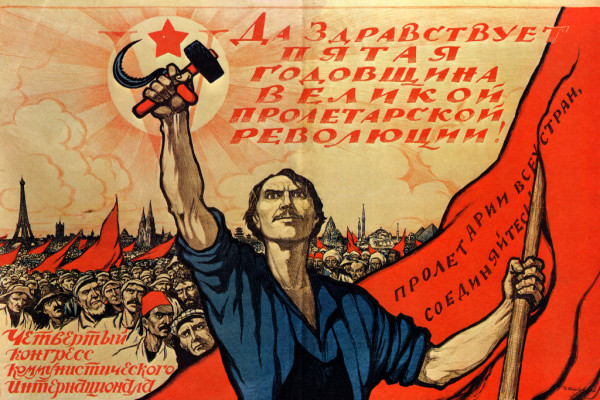
Communist Nostalgias
Pubblicato da : res publica : quaderni europei: giugno 2026
When traveling in a foreign country, tourists mainly see the monuments, traditions, and everything they expect to see. In Naples they hear people constantly singing classic Neapolitan songs; in Ukraine, people dancing like Cossacks. Yet it may actually happen that in Naples young people no longer sing the old songs but rap instead, while young Ukrainians dance to hip-hop.
It is therefore difficult to understand a country simply by traveling through it: to truly understand the reality of a nation, one must speak with its inhabitants outside the framework of traditionalist rhetoric.
It often happens to me to speak with people from Eastern Europe, not so much in those countries themselves, but among immigrants whom, for various reasons, I frequently meet.
What has struck me, as I have come to know them better, is the fact that there exists a certain nostalgia for communism. We think that the fall of communism was welcomed and regarded by everyone as a liberation, but in reality this is not so. We want to hear that narrative, and therefore, in order to please us and make themselves likable, immigrants indulge us. It should be clarified that this nostalgia mainly concerns people of a certain age, because obviously younger generations cannot remember a way of life and a society that disappeared about forty years ago. We might therefore consider this nostalgia simply as an expression of longing for youth, something natural among people of every nation and civilization. However, it seems to me that this is not the only cause, but that there is indeed nostalgia for a certain way of living.
There is also the memory of a time in which, despite poverty and hardship, there existed security and peace of mind. Work was guaranteed, nobody was unemployed, everyone had a house, schooling for their children, and all the bare necessities, even if in a very modest measure, apart from the nomenklatura, as it was called, which instead had everything in abundance.
In the modern society of consumerism, as it is often called, there is instead tension, uncertainty, frustration, and also greater crime and mental distress.
Thus one may prefer a calm but secure life to a prosperous life filled with tension (consumerism, as we in the West call it).
Certainly, where there is progress and development there is also more tension; there are winners and losers (as Verga said). Yet if humanity had been satisfied with what it already possessed without seeking progress, we would still be living in the Stone Age.
Nevertheless, it must also be acknowledged that security, even in poverty, may be preferable to insecurity amid prosperity.
It should also be clarified that this nostalgia is not for true communism, heroic and tragic, but for what is called “real socialism.” In all communist countries we can distinguish an initial phase in which attempts were made to achieve in a short time the society envisioned by Marx, in which “everyone gave according to their ability and received according to their need,” a society that was supposed to lead to true freedom and happiness. But these attempts ended in tragedy: Stalinist purges, the Maoism of the Cultural Revolution, the massacres of the Khmer Rouge. Then came a phase in which the establishment of Marxist society was postponed to an indefinite future, and governments limited themselves to a welfare state without the prosperity known in the West — or, as some prefer to say negatively, consumerism.
In reality, however, we should note that in our societies nobody forces you to consume: you can very well live spending only a few coins, but it does not seem to me that many people truly wish to do so. Perhaps only the few remaining cloistered monks and some intellectual nostalgic for a natural life. We must consider that if everyone owns a mobile phone or a car, it is because everyone wanted them. Obviously, those who do not want such things feel uncomfortable, but this happens to all those who differ from common social attitudes. Still, nobody prevents you from living in poverty and hardship as in the pre-industrial age, and some people do so, like the famous family that wants to live in the woods, but that is another matter.
We should also consider that nostalgia for the “good old days” is a constant throughout history. It is often said that in the past there was not all the evil (alienation, as people say) that exists in society today. Yet it is enough to read — not even history books, but merely some literature (for example, Les Misérables by Hugo or French nineteenth-century naturalism) — to realize how widespread crime and madness were in the age of poverty before industrialization. Ever since the time of Cicero, people have cried “o tempora, o mores,” but this is merely an illusion disproved by facts.
One need only think of the original versions of fairy tales such as Cinderella or Snow White to see the cruelty and ferocity of past times; and I am not referring to the Romans, who delighted in watching gladiators die in the arena, but only to a few generations ago.
Nostalgia for socialism is like nostalgia for the “good old days,” but the facts contradict it.
To evaluate real socialism, we must consider one fundamental element: there were always crowds of people trying to flee those regimes in order to reach the consumerist West. In Germany and Korea we had two nations divided by barriers; in Germany there was literally a physical wall guarded by soldiers in order to prevent masses of citizens from escaping.
If the regimes of real socialism had truly been preferable to the consumerist and alienating capitalism of the West, we would have witnessed the opposite movement. Yet it seems that very few people preferred to move to communist countries, and those who wished to go there were free to do so — but very few actually did.
The same argument can be made about anti-Americanism, still so widespread today, though mainly on a theoretical level, because in reality almost everyone would like to go to America: this is the fundamental point that must be considered. There may indeed be some who prefer security in poverty, but in practice very few people make that choice.
It may be said that material well-being is not so important for happiness; however, I would point out that the state can promote prosperity, but happiness is something personal. We are happy if the girl we love says yes to us, if our child is intelligent, and so on — but these are things the state certainly cannot guarantee.
I would also note that crime and mental illnesses (depression, for example) have always existed, even in pre-capitalist, feudal, and slave-owning societies. Indeed, it seems undeniable to me that they have decreased in modern times, even if we lack statistics for the distant past.