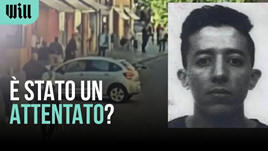
An incident that occurred in Modena a few days ago received extraordinary media attention: a car drove into a crowd and struck a number of pedestrians. The driver, armed with a knife, then attempted to flee, but was stopped by bystanders and handed over to the police. It emerged that the driver, a certain El Koudri, born in Italy to Egyptian parents and therefore an Italian citizen, as well as a university graduate in Italy, had deliberately attempted to carry out a massacre. It was later established that in previous years the attacker had been treated for psychiatric disorders.
The controversy and media attention surrounding the event are linked to the heated debates between those on the political right, who sought to interpret the incident as a consequence of immigration and Islamic fundamentalism, and those, generally on the left, who argued instead that it was simply a case of mental illness.
Without entering into the discussion about the effects of immigration and the danger of Islamic fundamentalism, it seems entirely evident to us that these issues have nothing to do with the Modena incident.
There are mental disorders, madness, which affect everyone regardless of culture or race, just like appendicitis or diabetes. To exploit this event in support of a particular thesis, even one that might otherwise be valid, seems foolish to me.
A different issue is the massacres committed in the name of religious extremism, which stem from a particular interpretation of reality: Catholics, Jehovah’s Witnesses, and Buddhists do not carry out terrorist attacks; Islamists do.
Another issue still is ordinary crime linked to poverty and hardship: those who have a job and a decent economic condition generally do not commit muggings.
Now, immigration may have some influence on terrorism and ordinary crime, but not on madness.
Generally speaking, we refer to an act as terrorism when it is carried out by an organization, whereas we tend to think of madness when it is the act of a lone individual. If a person shoots politicians because he believes the political system is unjust, we think him insane; but if the Red Brigades kidnap Moro and kill him, we think of terrorism or, according to some viewpoints, an incipient revolution.
It is true, however, that there are lone wolves in Islamic terrorism: yet it seems difficult to think of them as mentally balanced individuals. In reality, madmen may use as a pretext for their actions motivations that, in themselves, might make sense. Returning to the example of the Red Brigades, they targeted judges whom they considered accomplices of the regime; but killing a judge because the justice system does not function properly makes no sense — it is simply a mad act. Similarly, one may oppose certain excesses of feminism, but if one kills a woman solely out of hatred for feminism, we are dealing with madness.
One of his emails was also published, in which, exasperated because he could not find work, he wrote: “Christian bastards, you and your Jesus Christ on the cross. I’ll burn him.”
But Christians are one thing, Jesus another: for Muslims, Jesus is respected as a great prophet; they also venerate the Virgin Mary, and in any case Christians and Jews are “People of the Book,” who must be respected. Indeed, Christian communities have survived in the Middle East up to the present day.
There has also been discussion of the second generation, supposedly more inclined to hatred toward their new homeland and therefore more easily drawn to fundamentalist terrorism.
Now, it is true that second- and third-generation immigrants often seek out and rediscover their origins: this also happens, for example, among Italian emigrants in America. However, this certainly does not seem to be the case with El Koudri, who does not appear at all interested in rediscovering his origins and above all does not seem connected to Islam: he does not even attend mosques or any Arab-Islamic organization.
Nor can we interpret the episode as a consequence of social hardship or marginalization. The man even had a university degree: it is true that he could not find work, but this probably depended on his mental instability.
Even the fact that he was planning a massacre does not at all mean that his motivation was the shahada (profession of faith); rather, it appears clear that this was simply madness.
One need only think of the many massacres that occur in America, generally in schools, without any motive other than mental imbalance.
Some have also claimed that the blame lies with the motor vehicle authority, which had allowed the attacker to retain his driver’s license despite his instability. But this issue would only be relevant if he had caused an accident because he lost control of the car: this was instead a deliberate act of running people over; it has nothing to do with the ability to drive.
It has also been said that he later apologized, and that someone acting out of madness would not realize what they had done. But this is not true: someone who realizes they acted in a fit of madness may ask forgiveness and feel remorse. Others, on the contrary, may not realize at all what they have done: it depends on the case.
In conclusion, all these controversies have nothing to do with the Modena incident, which stems from mental disorders that exist in every civilization and that may use as a pretext elements drawn from a person’s culture — or anti-culture.
This year too, practically as every year, the celebrations of the national holiday of April 25th were marked here and there by disorder and clashes: something that does not occur in the national holidays of other countries and that runs counter to the very concept of a national holiday, namely that of the entire nation.
In particular, it happened that representatives of the Jewish Brigade marched waving Israeli flags and also, it seems, a portrait of Netanyahu, provoking strong reactions, especially from the more left-wing demonstrators inclined toward the pro-Palestinian cause. Indeed, bringing symbols of the Israeli government into a national celebration, at a moment when it is pursuing a bloody military policy, does not seem very appropriate; indeed, I would say it sounds in sharp contrast with the spirit of a national holiday. Whatever judgment each of us may give on current Israeli policy, it is an objective fact that it meets the opposition—indeed, I would say the indignation—of the greater part of the nation, and this fits poorly with the spirit of the commemoration.
At a certain point the Jewish representatives were forced by the police to step aside, and then there was talk of antisemitism: strangely, the celebration of victory over fascism was accused of being imbued with antisemitism, which is universally regarded as the most nefarious aspect of Nazi-fascism.
Leaving aside particular cases, the problem that arises is why a national holiday, which should unite all Italians, always ends in divisions and clashes among Italians.
For example, if we consider in France the anniversary of the storming of the Bastille, one has never heard of disorders taking place, just as in the United States for Independence Day on July 4th, or Thanksgiving in November giving rise to conflict and clashes; whereas such things seem to happen only in Italy.
The explanation, in our view, lies in the way the commemoration is understood. If it is a national holiday, the historical reality of the event commemorated is not what is at issue; rather, it assumes the role of a symbol, an emblem of the nation. If one celebrates the storming of the Bastille, one does not focus on the historical reality, in which it certainly was not an event shared by all French people of the time, but rather a violent, bloody conflict later marked by massacres and repression (one may think of Robespierre’s Terror or the repression in the Vendée). Likewise, American independence was also the outcome of a civil war (a historical fact that is practically ignored). The same applies to Thanksgiving: it refers to an event that has become symbolic, quite different from historical reality. Quite apart from the fact that there was no turkey on the tables—an essential element of today’s celebration—the holiday was promoted after the American Civil War as a manifestation of the religious spirit of the North (of the Pilgrim Fathers), in opposition to Black slavery in the South.
But all this is ignored, and North and South celebrate alike.
A symbol is something different from effective reality: if we say a man is a lion, we certainly do not mean he is a feline.
We too in Italy have many Piazza del Plebiscito, recalling annexation to the Kingdom of Italy, which historically was not exactly an expression of plebiscitary will: one need only think of the eruption of southern brigandage. We have streets named after Mazzini and Cavour without anyone reflecting that these two figures had very little in common, and that the Italy born of Cavour’s work was quite different from the one dreamed of by Mazzini.
In Italy, however, Liberation Day on April 25th has not become a symbol more or less detached from historical reality, but retains reference to a historical event that is, moreover, interpreted differently by political sides.
It is considered the birth of democracy, yet it is pointed out that the strongest component of the partisan movement was the communist one, which then had in mind a Stalinist Soviet model (“adda venì baffone”), very far from the representative democracy that later emerged. Above all, one should consider that part of the demonstrators believe that the current right wing, now in government, is fundamentally a child of fascism. But if a part of Italians—even, at this moment, a slight majority—does not share the ideals of the Resistance, then we can no longer consider April 25th a national holiday, which by definition is the holiday of the WHOLE nation and not of one part of it.
To consider April 25th as a historical event still unfolding, still current, as all the rhetorical speeches on that day repeat, would mean depriving that commemoration of the symbolic value a national holiday must have, as happens with Bastille Day, the Declaration of Independence, and Thanksgiving for Americans.
If, in short, we say “now is always Resistance,” then we are saying that one part of Italians is fighting against another part of Italians, and therefore it is impossible for all Italians to identify with it.
Hence the fact that it becomes an occasion for conflict rather than for national unity, as every national holiday ought to be.
To give an example: Christmas is certainly a Christian religious holiday; yet even those who are not believers celebrate it all the same, because it has set aside its original religious meaning and has become the celebration of the family, above all of children, as the continuation of life, of generations meeting one another, and everyone feels its charm.
If we were to consider Christmas only from a religious point of view, we would no longer have a celebration for everyone, but only an occasion on which believers and unbelievers would clash over whether the birth of Jesus is merely a legendary invention or whether in Bethlehem God himself truly became incarnate.