Trump’s unprecedented attack on the Pope has sparked a chorus of unanimous condemnation, something rarely seen in a modern world so divided on everything: moreover, this is not an isolated incident but only the most striking in a long series.
In our view, the problem is not the substance of what Trump says, which is an opinion that can be agreed with or not, as happens with most political positions. What is striking, however, is Trump’s way of expressing himself, which highlights a fact that has by now become undeniable: his pathological megalomania, an indication of a mind that is not entirely balanced. We are now faced with the reality that the man leading the most powerful nation in the world, with armed forces more powerful than any others and, moreover, with access to the famous nuclear briefcase, is not a particularly balanced person: a real threat to the entire world.
The issue is not, as we have said, his political moves, which can be supported or opposed like any political actions, but the way in which they are presented and announced.
The clearest example was the attack on the Pope. Trump stated that he is a weak man, that he does not fight wrongdoing (which wrongdoing? perhaps the evil represented by Iran?), and that he was elected because Trump was President of the United States.
One may also think that the Pope, in the current Middle Eastern crisis, does not fully grasp the situation, that war against Iran to prevent it from becoming a nuclear power is just and necessary; but it is the way Trump frames the issue that gives the impression of mental imbalance. First of all, it had never happened before that a political leader attacked the Pope so harshly, ignoring considerations of political appropriateness: in doing so, one alienates the Catholic electorate.
It should also be considered that the call for peace constitutes, so to speak, a pastoral obligation: no one in the Christian world today thinks anymore of holy wars such as the Deus vult of the Crusaders. Moreover, appeals for peace and reconciliation do not apply only to the United States and Trump, but also to the opposing Iranian side and its proxies; as the Pope rightly said, this is not a political discussion but a matter of the Gospel message.
The claim that the Pope’s election was due to Trump’s own election is completely meaningless: why would that be? One might even think the election happened despite Trump—but not even that. These are clearly independent events that happened by chance close in time. Is it really possible to say such nonsense?
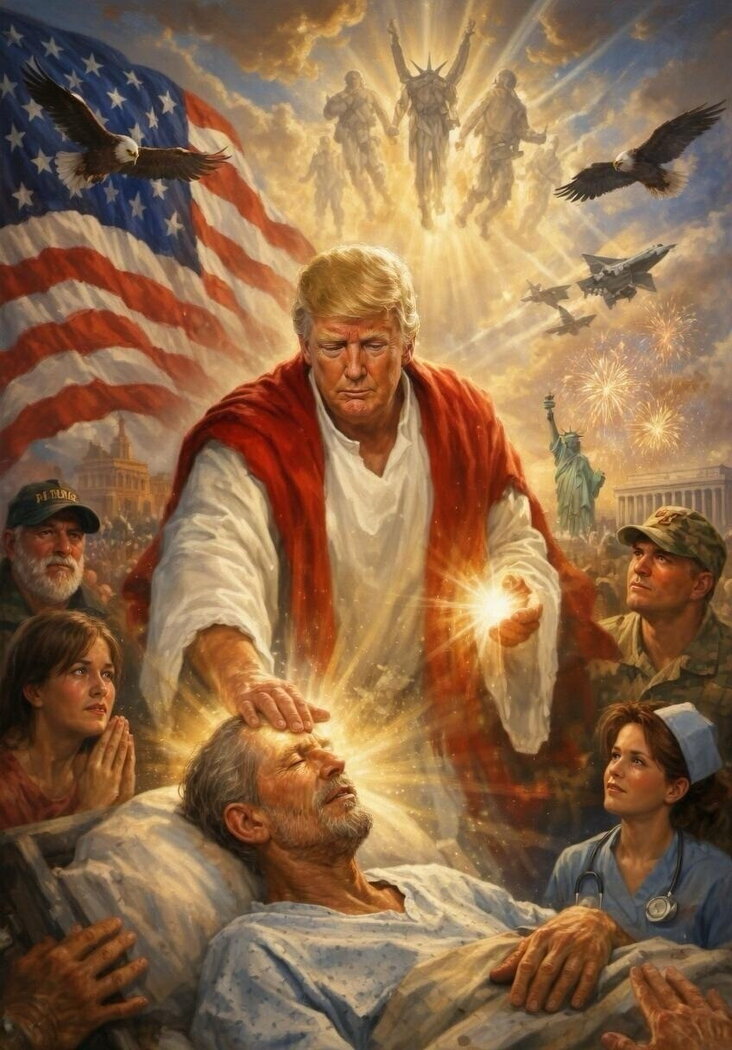
The situation becomes truly excessive—indeed, worrying—with the AI-generated image published on social media depicting Trump unmistakably in the likeness of Jesus, seemingly healing a sick person against a backdrop of weapons and war.
What does that even mean? Is Trump perhaps a new Jesus returned to Earth? What is really going on in Trump’s mind—something deeply concerning: one may believe in the divinity of Christ or not, but only a madman could consider himself to be Christ.
In the past, Trump had already portrayed himself on social media in the guise of the Pope: does he perhaps believe himself to be a religious leader as well?
Consider other social media portrayals, such as Gaza transformed into a luxury seaside resort, with Trump himself together with Netanyahu basking in the sun. One may argue that Gaza, at some point, should be cleared of its excessive population, even if it is hard to imagine how. But presenting such scenes at a time when people in Gaza are dying, when everything has been destroyed and desperate crowds wander among tragic ruins, is certainly inappropriate. It appears as a cruel insult to a decimated, starving population struggling daily for survival. One may think that all this is the fault of Hamas and not Israel, that the situation must in any case be resolved, and that perhaps one day—whenever that may be—it could become a vacation destination like Sharm el Sheikh; but it is clear that such a video is unacceptable. Does Trump really believe he can create, out of nothing, a vacation land where he might relax after his term?
We do not know; however, it certainly does not demonstrate the sense of balance and appropriateness that a politician, above all, should possess.
Let us also consider the many statements made in this war with Iran. How can one claim that there is no longer any need for NATO’s help because the war is already over with his victory? Perhaps we may think that in the end the United States will emerge victorious (who knows), but the war is certainly far from over. And then, at one point, there is the ultimatum of just a few hours, in which even the end of the millennia-old Iranian civilization—dating back to Cyrus the Great—is threatened.
But what sense does it make to speak of the destruction of an entire civilization? At most, we might think of a definitive defeat. In 1945, Japan and Germany were definitively defeated, but can we really say that German or Japanese civilization disappeared? What would that even mean?
In conclusion, Trump’s policies may have their reasons, they may be judged appropriate or necessary, but his statements and behavior reveal a lack of balance and a pathological sense of omnipotence.
He truly appears to be a danger to humanity.