Genocide in Gaza?
Pubblicato da In dies Info 11 aprile 2026
People commonly speak of genocide in Gaza, and the International Court of Justice has opened proceedings against Israel on this charge: obviously, this is only an accusation and not a verdict, which will presumably never be reached.
But what does genocide mean?
According to international law, under Article II of the Convention, genocide is defined as a series of acts committed with the intent to destroy, in whole or in part, a specific group of people identified by nationality, ethnicity, race, or religion, such as:
killing members of the group;
causing serious physical or psychological harm to members of the group;
deliberately inflicting on the group conditions of life calculated to bring about its physical destruction in whole or in part;
imposing measures intended to prevent births within the group;
forcibly transferring children of the group to another group.
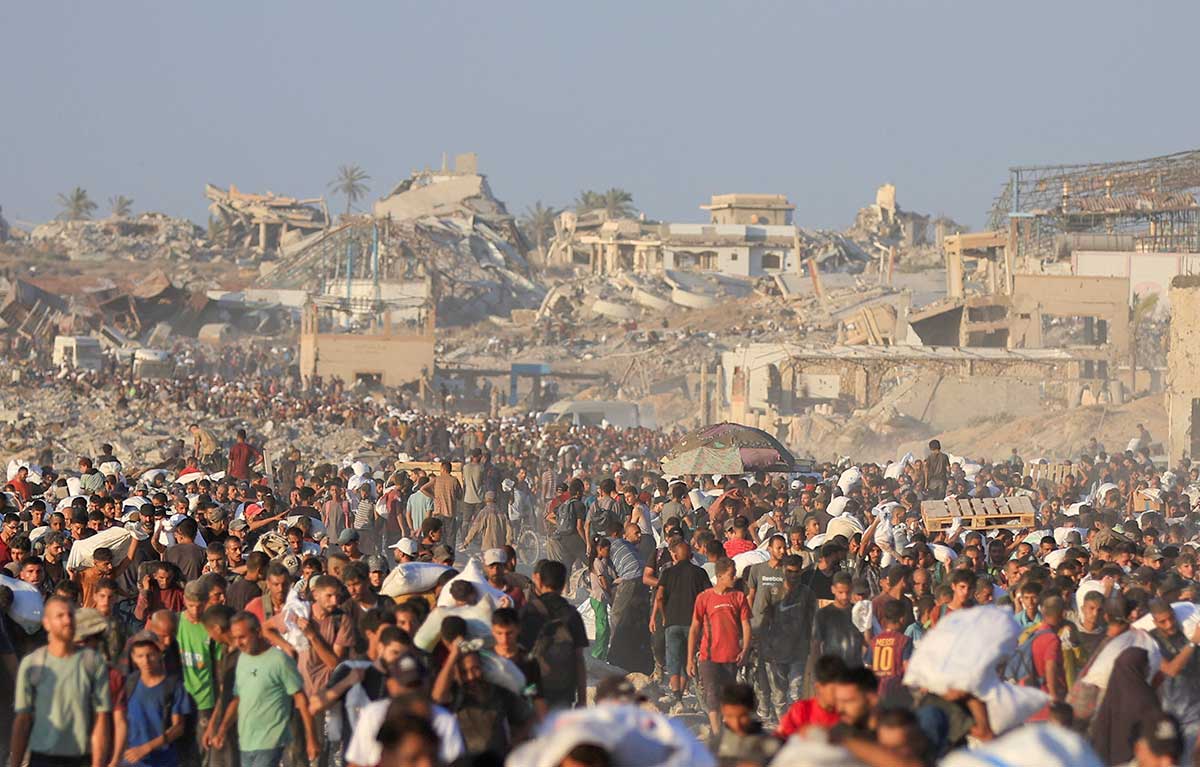
The accusation against Israel of genocide is based on the claim that it carries out indiscriminate attacks that strike both military and civilian targets without distinction, with the near-total destruction of Gaza’s critical infrastructure and other essential goods for the population’s survival (for example power plants, hospitals, and agricultural areas); the repeated, forced, mass displacement of 90 percent of the population under unsafe conditions; and the blocking or arbitrary restriction of humanitarian aid, including food, water, and medicine, leading to the spread of hunger, malnutrition, and infectious diseases.
It has also been noted that the collapse of healthcare facilities in Gaza makes it difficult to have children, which would rightly be considered an aspect of genocide: it is clear that if a people are prevented from having children, they are being driven toward extinction.
The concept of genocide
We will not address whether these facts— all true and indisputable— may or may not constitute the crime of genocide as defined by the criteria mentioned above. It is well known that in law one can always argue both sides, interpreting or quibbling over the rules, and it should also be noted that these criteria appear rather vague.
Consider, for example, the reference to living conditions making childbirth difficult: regardless of the fact that in Gaza more children have been born in these two years than the number of deaths (some months ago Hamas spoke of 50,000), by this criterion not only every war but even every economic crisis would become a genocide.
More generally: if we apply these criteria, then all wars (especially asymmetric ones) would be genocide.
We would then have genocide among the Houthis, the Syrians, the Kurds, the Iraqis, the Lebanese, the Afghans, the Sudanese, to limit ourselves to the Middle East.
Yet it seems that the court speaks of it only in relation to Palestine.
Let us also look at European history during World War II.
World War II was a conflict between armies in the field, yet bombings of civilians caused massacres far worse than those in Palestine. For example, in a single bombing of Tokyo, a few days before the atomic bombs, 75,000 civilians died, generally burned alive— as in Dresden— more than the number of Palestinians killed in two years of war.
And yet it was an open war between armies, not an asymmetric war in which one side consists of fighters (guerrillas) hiding among the population. Still, no one has ever spoken of genocide: no one says that the aviators who bombed Tokyo (Berlin, London, Rome) committed genocide.
Consider that during the siege of Leningrad, perhaps between 600,000 and one million civilians died of hunger and hardship; consider also the approximately two million deaths in Vietnam, and those in Ethiopia, the Congo, Chechnya, and so on: the list would be endless.
To speak of genocide, one must consider not only percentages but also the intent to eliminate an entire people: two conditions that are absolutely not present in Gaza.
The Russians suffered 25 million deaths, yet no one spoke of genocide; the Jews “only” 6 million, and no one doubts that it was genocide. Now, if the Israelis had wanted to kill all the Palestinians in Gaza, they could have done so, but they did not: I do not know whether out of humanity or fear of Western reactions— perhaps both— but it was not done.
In almost all wars over the last 80 years, civilians have been deliberately targeted, not out of wickedness but because modern warfare demands it: only in some rare cases, such as the Arab-Israeli wars (1956, 1967, and 1973), were civilians not involved, also because these were lightning wars, blitzes rather than prolonged global conflicts.
Casualties in Gaza
Let us first consider how many people have actually died in Gaza.
Hamas has provided a detailed and precise list, indicating a figure of over 70,000 dead, plus perhaps another 5,000 or 10,000 under the rubble, unidentified. The Israeli army has always denied this figure, calling it exaggerated, and many have considered it unreliable as it comes from a partisan source. However, in January 2026, unexpectedly, the Israelis acknowledged that this figure appears credible. We can therefore consider this to be the approximate number of victims.
Considering that Gaza’s population is estimated at 2.2 million inhabitants, this suggests that about 3% have been killed. If we consider that continuous bombings for over two years have destroyed about 85% of what could be destroyed, the number of casualties appears relatively low compared to other conflicts.
Figures have also been presented, according to Hamas sources, broken down by age and gender, as follows:
Children under 18:
20,179
Men, 18–59: 31,754
Women, 18–59: 10,427
Adults 60+: 4,813
In proportion to total casualties:
Under 18: 30%
Men aged 18–59: 47%
Women aged 18–59: 15%
Over 60: 7%
Considering that those under 18 make up 50% of the population but 30% of the casualties, it is quite striking that adult male casualties are three times those of women, even though their numbers are roughly equal.
How can this be explained?
This may be linked to another aspect of the war, previously overlooked and still largely unspoken, although reported by many sources.
Airstrikes were generally preceded by warnings; sudden and unpredictable attacks were directed at men believed to belong to Hamas. These were therefore bombings that, unlike others (for example in World War II), were relatively targeted. Obviously, when targeting Hamas members, families and neighbors— women and children— were also affected: the underrepresentation of children and especially the predominance of men over women (3 to 1) may be explained in this way.
We are therefore not dealing with a deliberate genocide, but with attacks that relatively attempt not to strike everyone indiscriminately, as has happened in many other conflicts, but primarily combatants.
Victims of war
I believe that a fundamental mistake is made in the West regarding Gaza: considering Hamas as a terrorist group like the Red Brigades. But the Red Brigades had no popular support, no real power: they were only a small group of extremists who imagined they could start a revolution; had they run in elections, they would not even have reached the threshold for representation.
By contrast, Hamas has long governed Gaza unchallenged and is supported without reservation by the population, which hailed them as heroes after October 7.
Hamas represents Gaza; it is Gaza. Moreover, it represents a significant part of the Arab world that sees the destruction of Israel as a precondition for Islamic resurgence.
This is similar to the relationship between Nazism and Germany in the 1940s: indeed, the German army fought with exceptional determination.
In these terrible conditions, the population of Gaza has not rebelled against Hamas: it could easily have driven them out, just as Hamas could have stopped the slaughter simply by withdrawing from Gaza; surrender would not even have been necessary.
This is not a matter of fighting Hamas alone, but of confronting an entire mindset that views this war as a struggle of believers against unbelievers— a metaphysical struggle of good against evil.
It is not about taking sides, but about understanding both sides, each of which, from its own perspective, has its reasons. Hamas and its allies believe that God assigned Palestine to Muslims, and that it would therefore be blasphemous to leave even a fragment of it to unbelievers; they see Jews as a spearhead of Western unbelief.
Similarly, the Haredim (Jewish fundamentalists) see Palestine as the land promised by God and therefore consider it blasphemous to leave any part of it to others.
Secular Israelis, on the other hand, fear that allowing the creation of a Palestinian state would have the same consequences as leaving Gaza: a constant danger at the border, an ever-present threat.
To us, the two-state solution seems natural, but we fail to realize that, for the parties involved, this solution appears impossible for opposite reasons.
In particular, Islamic fundamentalists are not madmen, but people who are consistent and, one might even say, heroic, facing the sacrifice of their lives without fear.
We, instead, try to interpret these events according to our own mindset, which is foreign to the parties involved.
October 7 was a horrific घटना, but it seemed a useful means to derail the Abraham Accords (that is, Arab recognition of Israel) by those who see not a conflict over a small strip of land, but a metaphysical struggle between believers and unbelievers, between good and evil, against the “great and the small Satan” (Nasrallah’s speech).
The massive destruction of Gaza, with so many deaths, aims to convince Hamas supporters that the war to destroy Israel brings only catastrophe, and that Allah, the merciful, does not intervene to defend his believers.
Hamas’s objective does not seem to have been achieved: Arab countries have done nothing to help the Palestinians. I have no idea whether Israel’s objective will succeed or produce the opposite result.
What seems evident to me is that demonstrations in the West do not help the Palestinians at all, but rather encourage them further toward the ruin of jihad (holy war).