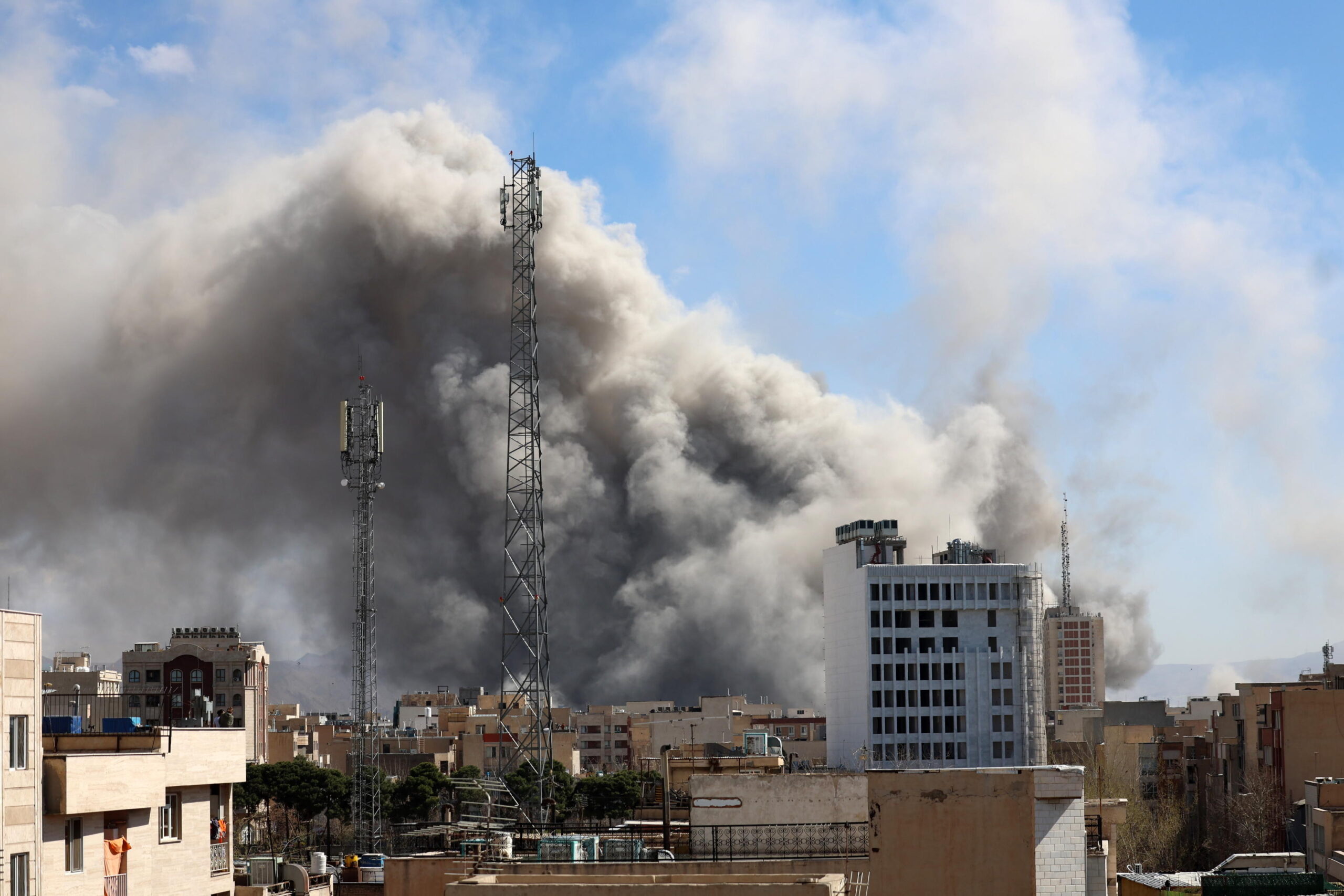
Expectations
Everyone is wondering what the outcome of the
ongoing attack on Iran will be, but we all know that
every war is known for how it begins, not for how it
ends. Let us say that if the outcome of wars could
be predicted, there would be no more wars, because
the losing side would not start them.
To give a few examples: Putin thought he could install a friendly government in Ukraine with a rapid military blitz, and the war has now continued for four years with no end in sight; in 1940 Mussolini thought he could make a demonstrative gesture by entering a war that seemed already over, and Italy emerged destroyed after five years. Examples of this kind could be multiplied endlessly.
So we do not know how it will end: one might think the Iranian regime will fall quickly, that it will instead grow stronger, that the conflict will last a few weeks or perhaps twenty years as in Afghanistan, or anything else.
We do not know: we can only examine the triggering causes and the situation at hand.
Beginning with Iran
The regime of the ayatollahs is a unicum in the
history of Islam: it had never happened before that
experts in sharia (ayatollahs—there is no Islamic
clergy in the Christian sense) took political
control, as has often happened with the clergy in
the Christian world (one may think, for example, of
the conflict between the papacy and the empire).
It is a completely isolated regime: Shiite fundamentalism is in conflict with the moderate regimes of all other Arab-Muslim countries, but it is also the mortal enemy of the other Islamic fundamentalism, the Sunni one (Bin Laden, ISIS, the Taliban).
Within the Iranian people there appears to be a deep division that periodically explodes into popular demonstrations; the latest of these, the bloodiest, occurred a few months ago. The opposition was initially represented by educated, middle-class groups and stemmed from the condition of women, but later another more widely felt reason was added, especially among the merchant class: the economic crisis. Sanctions and Iran’s continuous military interventions have exhausted the economy, and poverty and hardship are spreading.
However, we do not know how strong and numerous the opposition is: estimates range from 90% of the population to a small minority of “traitors.” Reliable data are impossible to obtain.
It must also be considered that only about 60% of Iran’s population is ethnically Persian, while minorities make up around 40% and are often, though not always, restive.
The regime is sustained by the massive presence of the Pasdaran (Guardians of the Revolution) and the Basij (mobilized volunteers), who permeate the entire social fabric and especially the economy, which has inevitably become a war economy.
These are highly organized and deeply embedded groups that so far have repelled and bloodily suppressed every opposition.
The regime could resist indefinitely or perhaps collapse suddenly, as happened with the Shah’s regime.
However, the regime maintains good relations with Russia and China, countries very distant from its ideology but sharing common economic interests: Iran has supplied drones to Russia and sells oil at low prices to China.
The Iranian Threat
In practice, Iran has remained the only Middle
Eastern country to support the struggle against
Israel, seen not as the reconquest of what is in
fact only a small territory but as a fight against
the infidels, of whom the Jews would be only the
advanced outpost, in the belief that the
backwardness afflicting the Middle East depends on
the aggression of the infidels (Westerners).
It is therefore a struggle seen in religious terms. Those who die in it are shahid (we translate “martyrs,” but literally “witnesses of the faith”); they will go to paradise, and the outcome of the war does not depend on weapons but on the will of God (inshallah), who will certainly grant victory to His faithful if they prove worthy through their faith. Islam, in fact, means submission (better, conscious acceptance) to the divine will.
The original Basij were very young men who, during the war with Saddam Hussein’s Iraq, advanced over minefields without weapons, blowing themselves up to show the soldiers following them how to proceed, certain that they would immediately be welcomed by the huris (virgin maidens) in paradise.
To this must be added the issue of nuclear weapons.
Iranians have always declared that they do not want the atomic bomb; there are even fatwas (religious rulings) declaring such weapons prohibited by sharia. However, the problem arises as soon as one notes that peaceful uses require uranium enrichment only up to a maximum of 5%: higher enrichment is used for atomic weapons or for research. It seems entirely clear that Iran does not have this second aim, and therefore that the goal can only be the atomic bomb, which would completely change the situation in the Middle East.
Thus, a state of 90 million inhabitants, in possession of long-range missiles and atomic bombs, driven by such a strong religious spirit, would be a mortal danger to Israel, whose defense and existence are considered an absolute priority by Western countries, especially America.
This appears to be the fundamental reason behind the Israeli-American attack, beyond more or less fanciful propaganda claims.
What the Americans Want
However, one must not think that the aim of Israel
and the USA is to import democracy into Iran.
Ideological wars in the West have faded away: the
only objective is to stop that danger and, if an
agreement can be reached, to achieve a different
political orientation (as in Venezuela). It matters
little whether there is democracy or dictatorship,
freedom or religious fanaticism.
Moreover, in the Gulf States—America’s allies and currently at odds with Iran—freedom does not exist, sharia prevails, and the condition of women is the traditional one.
In other words, from the Western side we are far from a struggle for freedom and democracy: after the failures of the neo-cons (in Bush’s time), that ambition has been abandoned, and it has been accepted that each country may govern itself as it wishes, provided it does not threaten us.
Proxies
Iran acts against Israel by pursuing its policy of
so-called proxies, that is, allied forces that are
guided and supplied by it.
At present, however, they seem to be in disarray.
Hamas shares the conception of war against Israel as a religious struggle; it is not Shiite but Sunni. However, at present it has been supported only by the Iranian Shiites and abandoned by the Arab Sunnis. It has brought ruin, destruction, and massacre upon the population of Gaza; nevertheless, it continues to resist and does not disarm.
Hezbollah (“Party of God”) are the Shiites of Lebanon who intervened against Israel, suffering continuous defeats and massacres and the hostility of all other Lebanese groups (Christians and Sunnis); nevertheless, they still resist with great courage (or folly, depending on one’s point of view). They have attempted to strike Israel and have therefore endured its retaliatory fury.
The Houthis take their name from one of the founders of the movement, but in reality they are a religious group, the Zaydis, who are not Shiite but are nevertheless associated with them and are in constant conflict with Saudi Arabia, a war that has caused, according to UN estimates, perhaps 500,000 victims.
They too have intervened in the Gaza war but have suffered heavy losses and destruction at the hands of the Israelis.
The Alawites in Syria once dominated the state but were overthrown and have retreated with difficulty into some fragment of territory. In fact, they are a religious sect not at all close to the Shiites—indeed of secular orientation—but strongly supported by the Iranians.
At the moment, the proxies are all unable to confront Israel’s modern army; yet, despite the disasters, they show no sign of retreating or surrendering to reality: the religious drive seems invincible.
Conclusion
In essence, we can say that on the Israeli side
there is a great superiority in weapons, technology,
and AI, which seems to have assumed an important
role; but on the other side, Iranians and Shiites
have the religious faith that sustains them and
makes them face every catastrophe.
Thus, the situation remains unpredictable, because neither side holds the winning card and both appear invincible: the one due to military superiority, the other because it endures every disaster.