UKRAINE: THE MAD WAR
Pubblicato da In dies Info 20 febbraio 2026
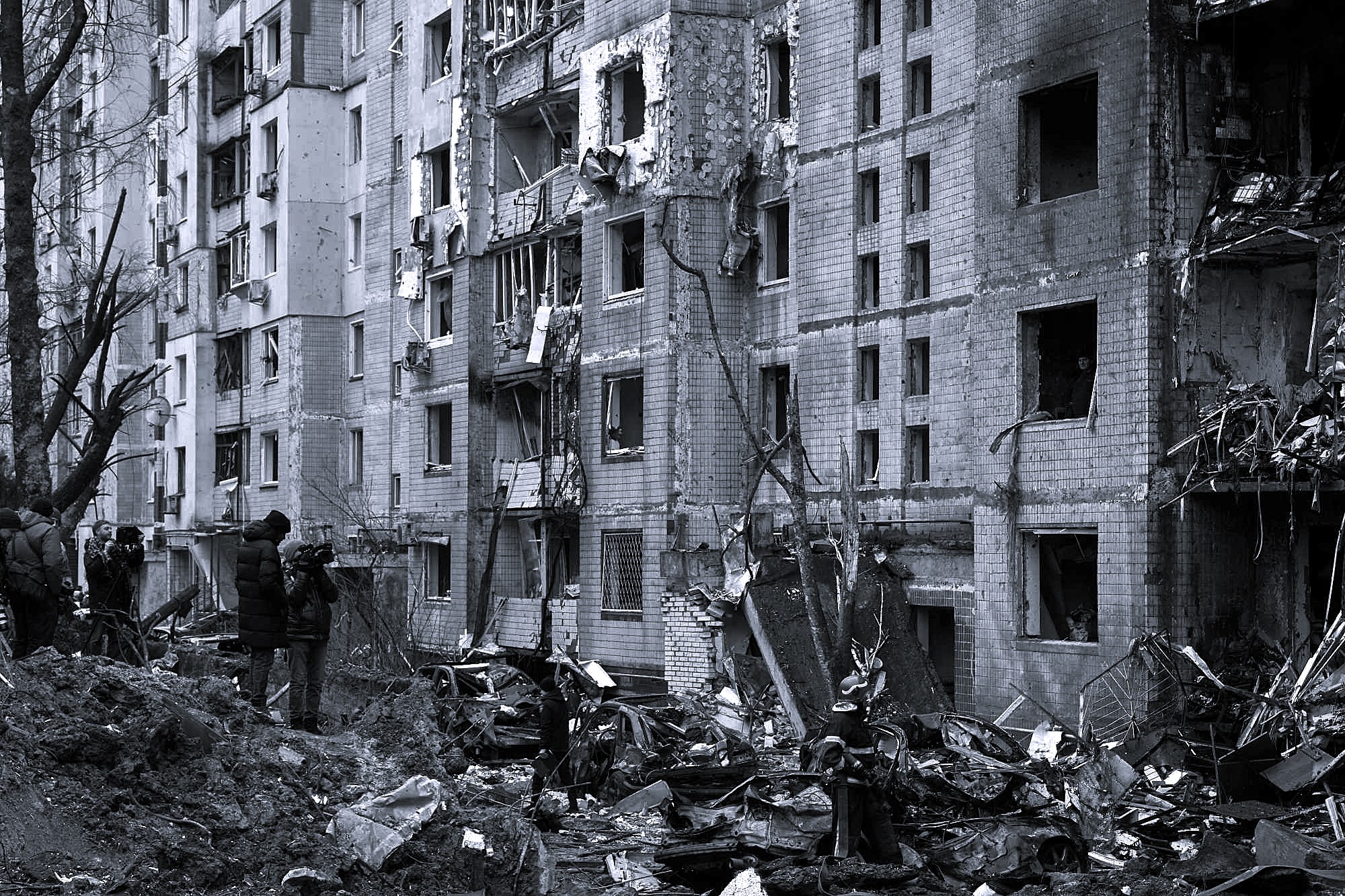
Gravity of the Conflict
The condemnation of Russia as the aggressor is unanimous: one can only agree, even if here and there some distinctions appear. But it seems to us that such condemnation is based almost exclusively on a formal fact: it is Russia that invaded the sovereign state of Ukraine in violation of all legality and international conventions—no doubt about that.
However, in our view, the real problem is that this reckless act may be the detonator of endless nationalisms and irredentisms that could flare up throughout the geographical and cultural space of the former USSR and former Russian Empire, triggering tragedies similar to that of Bosnia but on infinitely larger proportions. In Sarajevo too, Muslims, Croats, and Serbs had long lived together without major problems before everything went up in flames due to reckless nationalism.
I would say that with the dissolution of the USSR (which to us seems entirely reckless) it was truly a miracle that ethnic conflicts did not explode except on the margins (Azeris, Armenians, Georgians, and the tragic Chechnya).
The USSR, like Tsarist Russia, was an enormous country in which different ethnic groups lived intermingled. When, in ’91, each republic proclaimed its independence (as was theoretically provided for by the 1924 Constitution), each republic had a mixed population, generally with a minority of between one-third and one-quarter Russian speakers, while Russia has more or less the same minority of other ethnic groups. In this context, therefore, the outbreak of nationalism and irredentism risks becoming an endless catastrophe. For example, in Estonia the Estonian language was imposed (that is, Suomi, Finnish, a language of Ural-Altaic origin), which for Russians is almost impossible to learn, and so they were discriminated against and marginalized; but Estonia was part of the EU and nothing happened.
It would therefore be wise for each republic, although independent, to maintain good relations with Russia, as was also the case for Ukraine before the Orange Revolution and especially before the events of the Maidan in Kyiv in 2014.
As for legality, history is an endless sequence of violated agreements, not because of the wickedness of some but because of the demands of politics itself. Legality would in fact require an authority capable of enforcing it, but at the international level there is unfortunately no authority able to do so: the attempt of the UN has miserably failed.
It was not the will to respect legality or agreements that ended the endless wars that for centuries bloodied all of Europe, but the emergence of a new way of thinking after the disasters of the two world wars.
It is said that pacta servanda sunt, but this applies only sic stantibus rebus: if circumstances change, the pact no longer counts.
In 1991, in the Minsk agreements, there was talk of a Commonwealth of Independent States: that is, each state was independent but part of a community, somewhat like the British Commonwealth or the EU.
Has the principle of the Commonwealth of Independent States been maintained? It would seem not.
Let us try to clarify better the situation of Ukraine, about which in fact very little is known in the Western world.
From a legal point of view, Russia invaded a sovereign state, Ukraine—there is no doubt. But Ukraine has always been Russian; one third of its inhabitants are Russian; all Ukrainians also speak Russian; many Ukrainians live in Russia; there are countless marriages between Russians and Ukrainians, so that in effect it appears almost as a civil war.
The relationship is similar to that between Spain and Catalonia.
The Origins of the Conflict
Ukraine traces its identity back to the Rus’ of Kyiv, a state founded by Viking adventurers in the 9th century. Later this entity declined and in 1240 was overwhelmed by the Mongol invasion of Genghis Khan, and the whole territory was for centuries tributary to the Tatars (we say Tartars), that is, Islamic peoples who were remnants of the Mongol Empire. In the 1500s the Grand Duchy of Moscow became independent and for centuries expanded until it reached the extent of the immense empire of the Tsar, from the Bering Strait to Poland, from Finland to Kazakhstan.
Ukraine was contested between Poles, Tatars, and various Cossack brotherhoods until the mid-1600s, when the Ataman Bohdan Khmelnytsky signed the Treaty of Pereyaslav, after which Ukraine was annexed to the Tsar’s empire.
(These events are the historical background of Sienkiewicz’s novel and the related film With Fire and Sword.)
The western part, Galicia (today the oblast of Lviv), was Polish until the end of the 1700s, Austrian until 1918, returned to Poland until World War II, when it became Russian for the first time.
Present-day Ukraine also includes territories inhabited by Russian speakers, about one third of the population.
There are therefore three Ukraines: Galicia (an outdated name, around Lviv), Greek-Catholic and always in the Western orbit (Polish and Austrian), entering the USSR only in 1945; the central part (Minsk), Orthodox and part of Russia since the 1600s; and a wide area always Russian-speaking (the Donbass is only part of it). Moreover, Khrushchev had added Crimea for territorial continuity, though it had nothing to do with Ukraine historically or ethnically.
I would also add that it is not easy to distinguish Russians and Ukrainians, given that they formed a single state for 350 years. All Ukrainians also speak Russian; Russians living in Ukraine did not speak Ukrainian, but in recent years they have learned it (the language of schooling). So in practice all inhabitants of Ukraine are bilingual. The difference lies in the language spoken within the family: after all, it is like our dialects.
Until 2005 Ukrainian governments were decidedly pro-Russian or at least maintained excellent relations. Ukrainian emigration toward Western countries, many to Italy, led the population to orient itself toward the West, and the idea prevailed that entering the European Union would bring Ukraine the development and prosperity that emigrants had found in the West.
Thus in 2005 there was the Orange Revolution, a spontaneous popular movement that led Ukraine to request ever more insistently—but in vain—to become part of the EU.
Thus problems arose in relations with Russia, which in some way believes it plays a hegemonic role in the former Soviet republics and says it feels threatened by the expansion of the EU and NATO.
Much has been said about missiles too close to Russia, but they are already in Estonia a few kilometers from St. Petersburg; Poland and Turkey border Russia; nuclear submarines are everywhere. I do not believe it would make much difference if they were also deployed in Ukraine; no one is thinking of a nuclear war. The problem seems instead that Ukraine and Russia are culturally and ethnically very close; they belong to the same world, so a Westernization of Ukraine could also extend to Russia. In my view that would be good for Russia, but Putin thinks otherwise. Note that the Ukrainian state is much larger than the Ukrainian nation; it extends over a vast strip between Russia and the Black Sea, an area once perceived as southern Russia.
In 2014 there was the breaking point: with violent demonstrations known as the Maidan (in Ukrainian: square) of Kyiv, the leadership that wanted to maintain good relations with Russia was overthrown in the hope of entering the European Union. Subsequently the new leadership was democratically elected. However, it is not so easy for the West to accept Ukraine into the EU and NATO.
I have always told Ukrainian friends that theirs was a dream that would not come true because the West would not accept them, as in fact has happened in the last six years, and they have been left alone against the Russians.
Quite imprudently, on that occasion Ukrainian was proclaimed the sole official language, which served as a pretext for the subsequent uprising in the Donbass, inhabited by Russian speakers, and for the annexation of Crimea by Russia, later legitimized by a popular plebiscite—an annexation never formally recognized by Ukraine or the West.
Since then Ukraine has entered into crisis, endured a civil war that until the Russian invasion dragged on for six years with an estimated 14,000 victims, preventing the already devastated Ukrainian economy from developing, let alone entering the EU.
The new leadership then performed poorly and so an outsider was elected, an actor, Zelensky, somewhat like our own Grillo of the Five Star Movement.
The current invasion is universally attributed entirely to Putin’s madness. However, history cannot be explained by saying one man is crazy, another foolish. If an event happens, it is because there are reasons why it happens that must be identified and understood. Yet at some point someone makes a decision—perhaps a crowd, an entire nation. But the choice can be wrong, and usually in hindsight one understands who made the mistake. Now, even if there were reasons, Putin made a grave mistake in unleashing this war.
Presumably Putin did not intend to conquer Ukraine but only to give a strong shock, perhaps take Kyiv and force the government to flee. But events have surprised not only Putin but almost everyone: Ukrainians fighting desperately, world opinion rising up, NATO offering weapons, sanctions putting the already poor Russian economy into crisis.
Blitz wars do not always succeed: conquering all of Ukraine is too difficult. History is full of errors, blunders, mistaken forecasts—as is private life.
Solutions
What must be feared most is that in this way the conflict may continue indefinitely.
Peace is a difficult balance in which one tries to take everyone’s needs into account, and it is not always successful. There is no doubt that the aggression is Russia’s, but can we reach the end of the conflict without Putin obtaining something?
These are the problems to consider, while maintaining that it was Russia, and Russia alone, that violated legality.
It is often said that there is no peace without justice, but that is not true. Everyone thinks they are on the side of justice (Hitler thought so too), and there is no single criterion for identifying it. Therefore the only road to peace lies in an agreement, a compromise between the parties. Even here there are some who think Putin is right. If Ukrainians think they must make justice triumph—which they believe entirely on their side—we will have war and then war and then more war. We will have many young soldiers killed, with the tears of mothers and wives, the flight of terrified people, destroyed cities, and so on. If we want to avoid all this, we must seek an agreement, a compromise, not ask who is right and who is wrong, because each believes he is right and the other wrong.
There are moments in history when war is inevitable, but this is not the case. This war is senseless; whoever wins it will not change people’s lives. In the end, even if by absurdity Ukraine were to return to being part of Russia, the real life of the people of Ukraine would not change much.
When the Germans arrived in Lviv they were welcomed as liberators, but then revealed their mad plan to enslave the Slavs: in that case there was no alternative to war. In Kharkov (now Kharkiv for Ukrainians) four battles were fought during World War II with hundreds of thousands of dead (perhaps half a million), but now fighting for Kharkov is a useless folly.