Empires and Ideologies
Pubblicato da In dies Info 9 gennaio 2026
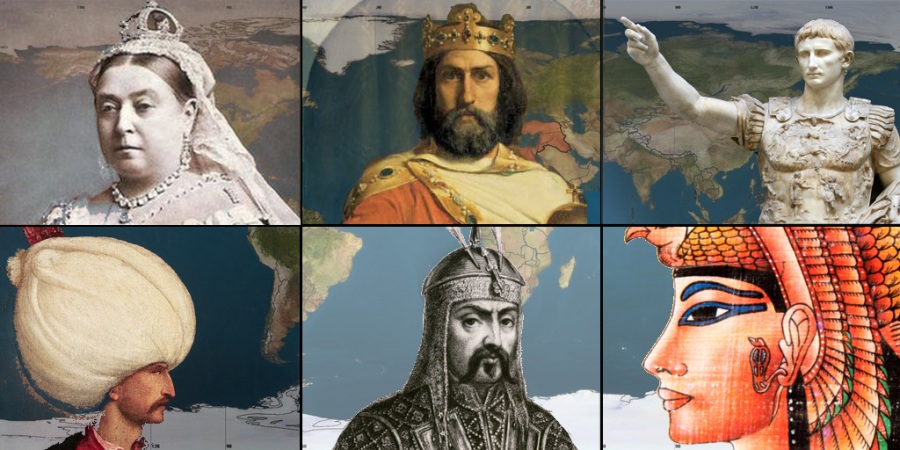
Empires
It is often said, more or less everywhere, that we have entered
a new era, that of empires, in which the great powers—above all
Trump’s United States and China, along with others that are not
yet clearly identified—are dividing up the world.
To address the issue of the return of empires, it is of course
necessary to clarify what we mean by empire, a term that has
assumed many different meanings throughout history. In general
terms, we call an empire a state that unites different peoples,
whereas by state (kingdom, republic) we mean a state of a single
people (France was a kingdom, Russia an empire).
The term refers back to the ancient Roman Empire, which unified Mediterranean civilization through the continuous conquest—generally violent and bloody—of other territories by a single state, Rome. We have always regarded that Empire as the origin of our civilization. The term therefore did not have the negative connotations it has today, and the same was true in China, India, the Americas, and more or less everywhere else. With Charlemagne, the Holy Roman Empire took shape in Europe, referring back to the Roman Empire and to Christianity. In reality, it had little political weight, since the various states, fiefs, and communes were in practice independent, but it had great ideological value.
Later, the term empire (Austrian, Russian) was used for those multinational kingdoms that united different peoples and lands. Similarly, the term colonial empires was used when Europeans, from the 16th century and then in the 19th, conquered lands outside Europe, considered uncivilized and of inferior civilizations, while also presenting themselves as bearers of a superior civilization.
In today’s world, the idea of multinational empires has definitively faded, even though multinational states still exist; but no state seeks to expand its borders by conquering other peoples.
The war in Ukraine is often seen as a return to territorial conquests; in reality, it is instead a conflict linked to the dissolution of the USSR, from which states emerged whose borders do not correspond to ethnic composition. In all the former Soviet republics, on average, about a quarter of the population belongs to other ethnic groups. Moreover, the war did not arise over territories but in order to install in Ukraine a friendly government that would not allow Ukraine to enter NATO, which Putin considers a threat.
Colonial empires generally
dissolved without tragic wars fifty years ago, and no one thinks
of reviving them.
Therefore, speaking of a return of empires understood in any of
the historical senses appears entirely unfounded.
We can instead speak of spheres of influence, that is, of the fact that a more important state ends up influencing a series of other states for economic, political, and military reasons, which is something different from an empire. It should also be borne in mind that, both at the level of state politics and at the private, personal level, one must always consider the consequences of one’s actions. If a state imposes tariffs on imports, it must expect others to do the same and therefore evaluate the consequences, just as in private life, if one does not go to work, one must take into account that one may be fired. No one, rationally—neither states nor individuals—can do whatever they want without assessing the consequences.
Ideologies
There are also ideologies, which are ways of evaluating facts
based on principles considered clear and self-evident but not
shared by everyone. They can come into conflict, giving rise to
a kind of civil war that transcends state borders. Some states
then take sides one way or another, but there always remain
minorities, more or less significant, within each of them.
Let us give a few quick examples. In the Middle Ages there was a clash between Guelphs and Ghibellines, depending on whether one supported the primacy of the pope (the Church) or of the emperor (secular authority). In any case, authority was always referred to God (nulla auctoritas nisi a Deo), and the difference lay in whether it fell to the pope or to the emperor. In reality, however, the division soon ceased to be ideological and became merely a pretext for identification.
With the Protestant Reformation, tragic wars of religion broke out in Europe between Catholics and Protestants (the latter themselves divided into many currents), which devastated Europe, especially Germany.
With the French Revolution, the clash became primarily political, though with strong religious implications as well. Europe fought fiercely between monarchical (or imperial) absolutism and governments considered designated by the people (by divine grace or by the will of the people), followed after 1815 by a conflict between liberals (of many different tendencies) and reactionaries, which then intertwined with the conflict between the principle of nationality and that of monarchical legitimacy.
Another great conflict occurred in the last century among three ideologies: capitalist (or liberal) democracies, fascisms, and communisms. Fascisms collapsed after the bloodiest war humanity can remember; democracies and communisms then struggled in the so-called Cold War (which nevertheless caused millions of deaths, especially in the Third World, the true battlefield) and ended with the sudden and unexpected collapse of communism.
A new ideological war emerged with the resurgence of Islamic fundamentalism, which rose up against the prevailing moderation of nationalist Islamic governments that were increasingly drawing closer to European culture, with its associated secularism. The conflict has also had repercussions in the West, especially after September 11, and still persists in the Islamic world, particularly in the Middle East.
Protagonists of History
We must now consider that European and world history sometimes
has states (or empires) as its protagonists, and at other times
primarily ideologies and their related conflicts; primarily
because the two components are always present.
Let us now look at the last few centuries of history, which concern Europe more closely. From the mid-16th to the mid-17th century, ideological clashes in the wars of religion prevailed. From the 17th century to the end of the 18th, there were clashes among various states (absolute monarchies) for the European balance of power, in which each sought to prevail and to expand at the expense of its neighbors. With the French Revolution, there was a clash between liberal (democratic) governments and monarchical absolutisms, which after 1815 intertwined with the conflict between the principle of nationality and that of legitimacy (for example, our wars of independence).
From the mid-19th century until the end of the First World War, states (nationalisms) instead prevailed. Subsequently, fascisms, democracies, and communisms clashed tragically. About forty years ago, with the collapse of communism, ideological conflicts seemed to have ended, and for a brief moment (brief by the standards of history) the United States appeared as the sole world power, capable of influencing the entire world. The outbreak of Islamic fundamentalism led the United States to believe that it could be destroyed through the establishment of Western-style democracies in Islamic countries (the export of democracy), thus an ideological struggle. But this attempt resulted in a resounding failure; fundamentalism, while continuing to pose a threat, proved incapable of truly seizing power.
Moreover, the majority of the world’s inhabitants have by no means adopted democracy, as many believed twenty years ago; therefore, the attempt to export it has been abandoned. We maintain peaceful relations with the dictatorships of the rest of the world (Arab countries, China, etc.) and think that each state should govern itself as it wishes.
We therefore no longer have
ideological conflicts at present.
As a result, states and their interests—especially economic ones—come
to the forefront.
The current problem of the West is that products from China and other poorer countries compete with ours both internationally and within our own countries, and the same can be said of the relationship between the United States and Europe. Another problem is raw materials, whose availability is essential for our economies (oil and now rare earths).
Thus, for example, Trump’s United States cares little about the freedom of Venezuelans but very much about the availability of their oil, just as China does not care at all about the Western political system, so different from its own, but rather about access to its markets.
In short, I believe that we
are moving—or rather, have already moved—from a world in which
ideologies were the protagonists to a world in which states are
the protagonists.
Many people, especially in Europe, do not realize this, but in
the rest of the world the situation appears much clearer.
T