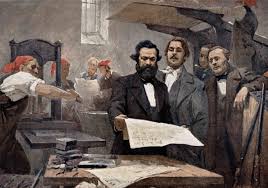
Marxian thought presented itself as a scientific form of thought, based on facts rather than on more or less vague ideals or aspirations, in a context in which the idea was gaining ground that only science constitutes true knowledge. In the scientific field, if facts do not validate a theory, the theory is changed; historical facts, however, have refuted Marxian predictions, but Marxists—particularly the few epigones who still today refer to Marx’s thought—do not accept the facts. As Popper observed some 80 years ago, when facts refute Marxian theory, Marxists, instead of changing the theory, change the facts.
The non-acceptance of facts today occurs above all because the basic concepts of Marxist thought are confused, stretched, and lose the meaning they historically had: communism, inequality, capitalism, democracy, and so on become uncertain and vague ideas.
Before entering into the substance of the matter, let us recall that, from a logical point of view, every word does not mean what it means, but what the speaker intends. Thus, for example, Manzoni’s bravi of the seventeenth century were the opposite of the modern meaning of “bravo”; love can mean anything from love for God to sexual relations, and so on.
Now, when we speak of democracy, communism, absolutism, we mean those that have actually been realized; if instead we give these terms vague and different meanings, it becomes very difficult to make a meaningful argument.
Predictions
The fundamental prediction of Marxian thought was that capitalist society would become increasingly polarized into the very rich (capitalists) and the very poor (proletarians), with the disappearance of the middle class, which would necessarily and ineluctably lead to the collapse of capitalist society and thus to communism, in which “each would receive according to his needs and give according to his abilities.” It was an inevitable process, scientifically certain like the evolution of species, as was said at the time: it was only a matter of time. The process could be accelerated by a more or less violent revolution, or slowed down violently through repression and, even more effectively, through false ideologies, such as the religious one that promised bliss in another life, enduring and resigning oneself to the misery of this life.
In reality, the facts have completely refuted the basic prediction of progressive impoverishment, of the growing poverty of the masses, and of the dissolution of the middle class.
In societies governed by capitalism, the middle class has not disappeared; on the contrary, it has grown and represents the great majority of the population, leaving on one side pockets of marginalization and poverty—always present but more or less assisted—and on the other side small groups of the very rich, defined as entrepreneurs (and no longer capitalists).
In the last century there was competition between liberalism (capitalism) and communism: the former achieved levels of well-being far superior to the latter, with the result that communism dissolved throughout the world.
This is a clear and evident fact.
Communism led to the death by starvation of millions of people in Russia, in China, and even more so in Cambodia.
With Maoist follies, China was a vast expanse of shantytowns; with the new, practically neo-capitalist course, it has become a forest of skyscrapers: such rapid development has never been seen in history.
Thus, the theory is not changed but the facts are: the blame for these terrible events, as well as for the horrors of the Stalinist purges, the Maoist persecutions, and the massacres of the Khmer Rouge, is placed on their enemies.
Above all, however, the meaning of communism is altered: communism would no longer be what was realized in a large part of the world in the last century (real socialism), but a different model that these regimes would have betrayed.
Communism thus becomes something different from what, a few generations ago, all those who declared themselves communists saw as the goal to be achieved: people used to say “adda veni baffone”; let us recall the unforgettable Don Peppone of the Don Camillo series.
Now, if by communism we mean not what was historically realized and we give it fanciful, utopian characteristics, it is clear that by changing and expanding the concept we no longer accept the real facts that occurred and thus, as Popper observed, instead of changing the theory we change the facts.
On the other hand, it takes little to understand that real communisms deviated from the Marxian line because it clearly appeared unrealizable and, when it was truly attempted, the greatest disasters occurred (Mao and Pol Pot).
The well-being that spread in the West in the last century, to the astonishment of populations who could not believe their own eyes (one may think of the so-called economic miracle in Italy), was called consumerism.
An austere society was proposed as the model to follow against the abundance of products, what is commonly defined as well-being.
Now, this theory may have value from an ethical point of view, especially a religious one, but the escape from need—the achievement of well-being—was precisely what Marxist communism promised to poor and hungry peoples.
Capitalism and Democracy
Among the epigones of Marxism, the meanings of capitalism and democracy lose their historical significance and thus become something that, as regards capitalism, is always present and, as regards democracy, something that never exists.
By capitalism we mean what Marx meant: the phenomenon that began in the eighteenth century whereby some wealthy individuals bought the machines then being invented and thus, through them, increasingly developed their wealth, exploiting the labor of workers, etc., etc.
This is not a question of merit, but simply a semantic fact.
If instead by capitalism we mean all societies in which economic and civil differences exist among citizens, then all societies are capitalist.
Thus, capitalist would be both liberal and communist societies, both agricultural and subsistence societies, perhaps even feudal and slave societies. Then the term “capitalism” indicates nothing precise, and neither does the argument we make.
Even in the USSR and in China there was no capitalism, but only oligarchies ruled.
Then Stalin or Pol Pot, Robespierre and Charlemagne can be considered capitalists.
If we then broaden the concept of capitalism to the point of making it coincide with evil in general, then certainly war is capitalism, as are femicide, prostitution, theft, murder, and so on.
In order to discuss, one would then have to define what is meant by capitalism, another Marxian term now obsolete, as Marxism itself is.
Some Marxists say that democracy exists when certain conditions are met that in reality are not met; others may say that democracy exists when there is a separation of powers, or when there are no wars, or when there is social justice, or when there are progressive taxes, or when LGBTQ people are not discriminated against, etc., etc., and infinitely many other things.
In this way everyone is right, and therefore no one is right.
To be conclusive, instead, one must start from how democracy exists in reality, propose corrections, and discuss their positive or negative aspects, and above all the possibility of their realization.
We must mean something that actually exists, for example democracy as the Swedish, English, or American system; then we will have a conclusive discussion, addressing its limits, its flaws, and the way in which it could be improved or worsened.
Democracy, in reality, means that rulers are elected and that, above all, there is freedom of expression.
The level of taxation and wars are political decisions that can be taken democratically or not.
There is then a tendency to call democratic those political decisions that we agree with; for example, some parties call themselves democratic, but all parties that participate in elections accept democracy.
It seems almost a universal fact that every civilization and every culture considers itself superior to others. Even the great Aristotle said that barbarians (i.e., non-Greeks) were by nature meant to be slaves to the Greeks (of all things!).
This phenomenon is explained by the fact that we judge according to the parameters of the civilization to which we belong, and thus we inevitably feel superior to those who have different parameters. They, in turn, will feel superior for the same reason. For example, the veil worn by women seems like a barbarity, a madness, to us, but for other civilizations, we are the barbarians and the fools.
It is an illusion, I would say, almost inevitable. Like all civilizations, we modern Europeans also tend to think that our principles are the true ones, or at least the superior ones. In this way, however, we end up not understanding cultures and civilizations different from our own. We could even say we refuse to understand them, but in reality, there are other cultures and mentalities that we are unable, and unwilling, to understand.
This attitude of superiority is perhaps most noticeable in our own left, as it tends to exalt the new values of the West (which they call progressive) and is therefore more inclined to believe that these values are universal and self-evident. In fact, with wokeism, we have an intolerance, which is a misunderstanding, of our own past that is even stronger than that for other civilizations. I want to clarify that I do not intend to show opposition to progressives in general, but merely to make an observation.
But the right also feels superior, perhaps by insisting on other values. For example, during the Bush era, the neo-cons thought that if Arabs would just try the Western liberal-democratic system, they would embrace it with enthusiasm. This was not the case, and a tragedy ensued.
Let's say that the veil, wokeism, and Bin Laden's jihad, while not being expressions of an entire civilization, are nonetheless reasonable ideas within the cultures in which they appear. We can say in summary then that a civilization judges itself based on its own values (ethnocentrism of cultures, as historians call it).
This is not just about a few errors—always present—in understanding another culture, but precisely about failing to recognize the cultural context and the principles from which every single action takes on its meaning and significance. In short, for us, a Bin Laden is a madman, and we do not realize that in his context he is a perfectly coherent person, perhaps too coherent, while we are the ones who appear to be the madmen to him.
It also happens that, in a religious context, superiority is made to ascend to the divine: a classic case is that of Judaism, which considered itself the people chosen by God.
The ethnocentrism of civilizations should not, however, be understood as ethical relativism, like that of the ancient sophists. For them, in fact, everything is true and everything is false; one can prove everything and the opposite of everything, so much so that the sophists were famous for their double discourses in which they would argue one thesis and immediately after another. For ethical and cognitive relativism, therefore, in reality there is neither true nor false, neither good nor evil, but only the ability to make what we desire to be considered as good and true appear so.
In the variety of cultures, however, within each of them, good and evil, true and false are still clearly distinct: the difference lies in the fact that they are identified differently, not that they are ignored. Returning to the example of the veil: for Islamic civilization, wearing the veil is a good thing, an expression of femininity, a rule that preserves the order of society and the family. For a Westerner, on the other hand, it is a sign of sexual discrimination, a humiliation of women, the sign of a backward and unjust society. Each person is therefore very sure of their own opinion and considers the other's to be wrong, but neither of them believes that there is no difference between wearing the veil and not wearing it.