INTERNATIONAL LEGALITY AND THE WAR IN UKRAINE
I do not believe that crises and major
international issues can be addressed on the basis of international law norms
and the unilateral inviolability of international agreements.
What spreads today, mostly at the level of propaganda, is the idea that
relations between states are governed by rules that everyone respects: this is
not true at all. No one respects these rules— not out of ill will or arrogance,
but more realistically because it is not possible to do so, at least until there
is a world power (a universal empire) capable of imposing itself on everyone.
Within a state, in fact, there are precise
norms and above all a coercive power that forces people to respect them and
imposes appropriate punishment on those who violate rules and agreements (contracts).
I may even think that I can beat my wife if she misbehaves (as used to happen in
the past), but a law prohibits it and therefore I end up in prison (sometimes
even for much less).
International norms, usually projections of Western culture, are not shared by
all. For example, gender equality is not shared by everyone: the Qur'an
contemplates cases in which the husband can (indeed must) beat his wife. Above
all, interpretations of facts may differ. Everywhere the immodesty of women is
condemned, but for us Westerners immodesty means, for example, going naked in
the street or even wearing a bikini at school (though not on the beach), while
in an Islamic country it is enough simply not to wear a veil.
When we extend these differences to the international level, conflicts arise: wars, revolutions, and terrorism erupt because one side believes it has no other means to assert what it considers justice and truth, while the other side believes the opposite. Violence would be unnecessary if justice and truth were universally shared in every situation.
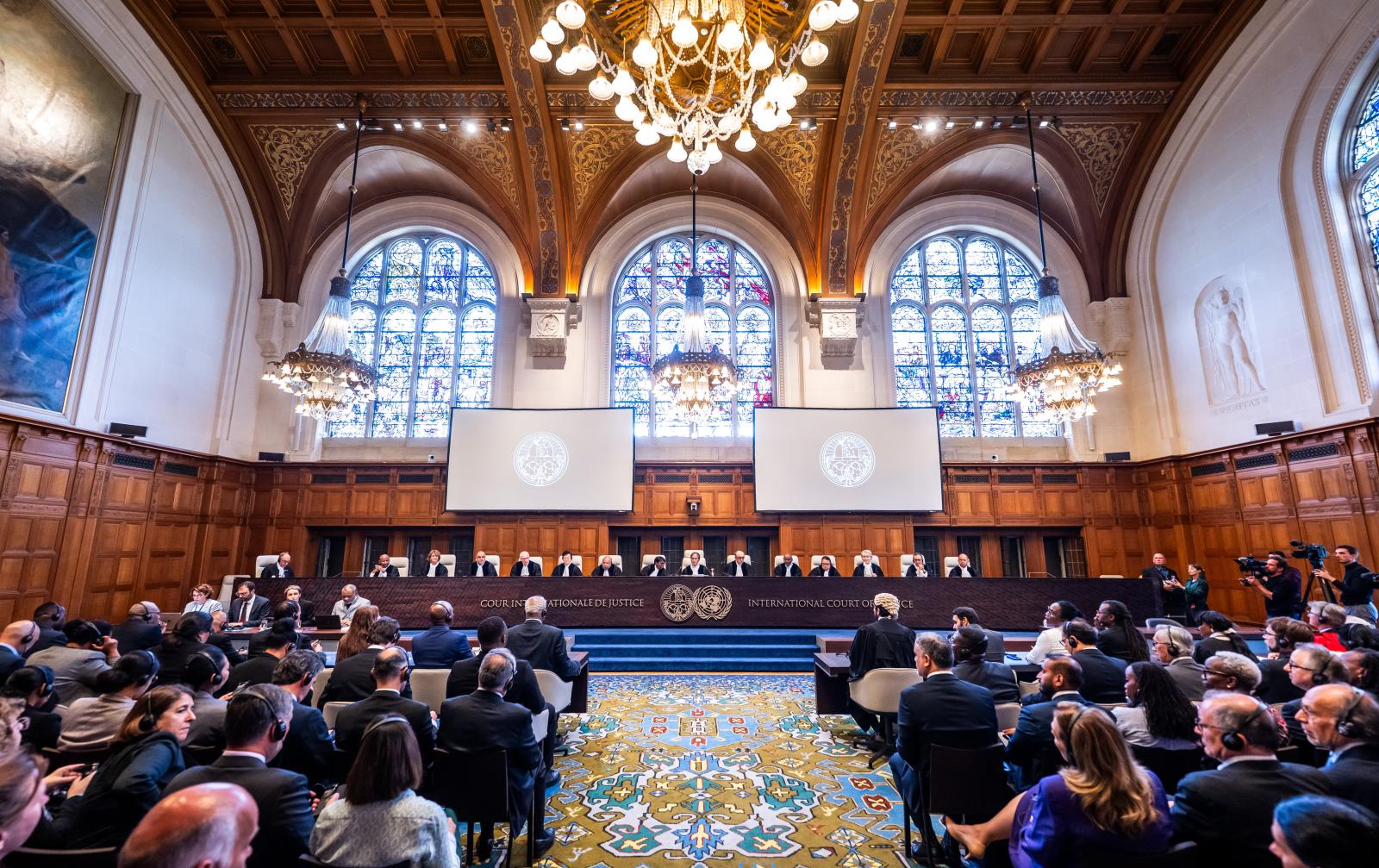
People speak of international courts of
justice: but is it realistic to think that judges whom no one knows, and whose
selection process is unclear, issue arrest warrants against this or that head of
state? Does anyone really believe that the war in Ukraine or Gaza could be
solved by arresting Putin or Netanyahu?
Bear in mind also that historians do not judge who is right or wrong in human
affairs but simply indicate the causes and the different interpretations and
values that parties assume in both peaceful and violent conflicts throughout
history.
In the international sphere, aggression appears to be the most important element: the state that commits aggression is guilty; one must not give in to invasion because this would create a dangerous precedent for international order.
But even the concept of aggression to change
borders by force must always be viewed within a broader context, within the
ideologies that motivate it.
For example, what we call the Italian Wars of Independence were, from the
standpoint of international law, wars of aggression aimed at changing the
borders of the Austrian Empire; the exploits of Garibaldi’s volunteers were an
aggression against an independent state by people coming from abroad. But for us
they were just and glorious wars, and Garibaldi’s men were pure heroes.
In Italy we welcomed the Americans as
liberators with joy, because it meant the end of war and deprivation; American
soldiers threw chocolate from their tanks—something we had long forgotten—along
with cans of meat that we starving people had not eaten in ages. And the
Americans were different, yes, but ultimately like Westerners; indeed, many of
them were actually Italians who lived very well in America, a promised land for
many of us.
In Russia, the Germans were the enemy, those who sought Lebensraum, who wanted
to reduce Slavs to slavery; they killed and massacred, they certainly were not
liberators: they did not throw canned meat and chocolate, but shells and bullets.
What else could the Russians do but fight them to the end?
From a general standpoint, the Allies were invaders just like the Germans, but
the evaluation of the facts made the former appear as liberators and the latter
as the absolute evil.
There is also talk of respecting international
agreements: whoever violates them is guilty; pacta sunt servanda would be the
fundamental principle of international justice.
In reality, both in the past and present, international agreements hold rebus
sic stantibus (if the facts have not changed). Two or more states make an
agreement because they consider it convenient; if they no longer consider it so,
it is because circumstances have changed.
Private contracts are valid indefinitely, but
even they have limits: if a contract becomes unexpectedly too burdensome for one
party, it is accepted that it may no longer hold.
Marriage, too, is an agreement “forever,” in sickness and in health, in wealth
and poverty; and yet divorce is contemplated—it too is rebus sic stantibus. But
in these cases there are norms valid for all, judges who apply them, and a power
that enforces them: none of this exists internationally.
Italy joined the Triple Alliance at a certain
point to escape a dangerous isolation due to tensions with France, yet switched
to the Entente in WWI when it believed it was the right moment to seize Trieste
and Trento.
In WWII, France and England accepted the invasion of Czechoslovakia believing
that Germany would then stop in its declared aim of “liberating” (i.e., annexing)
Germans remaining in other states.
However, when Germany invaded Poland a few years later, France and England
believed these were merely pretexts to dominate the entire world, and in
particular to create the Lebensraum.
Today, with hindsight, we think they were right and that they were wrong about
Czechoslovakia. Two practically identical invasions produced opposite responses,
confirming that history is driven not by legal facts but by historical–political
evaluations.
Even the non-aggression pact between Germany and Russia was made for that specific historical moment: a couple of years later Hitler thought it was time to invade Russia; if Stalin had thought it was time to attack Germany, he would have done so without hesitation.
UKRAINE
In Europe the prevailing idea—by far—is that this is a Russian act of aggression, a violation of rights; in Russia, however, the prevailing idea is that it is a defensive intervention. In the rest of the world support for Russia prevails. The Chinese say it is an American plot. Roughly calculated, the majority of humanity justifies Russia’s attack.
Some say that borders have not changed since WWII and therefore the transfer of Donbass to Russia would break this principle that ensured peace in Europe. This is certainly true, but states have been dismantled, and this has sometimes led to wars over internal territorial divisions.
We recall the terrible example of Yugoslavia, where horrific clashes among Serbs, Croats, Albanians, and Muslims burned for many years over internal borders, ending only after NATO’s intervention (an invasion?), though no one considered changing external borders. For example, Italy did not attempt to retake Istria.
We also recall the terrible clashes in India,
with ethnic cleansing, millions of deaths, and three wars between India and
Pakistan. And we could go on with many states of the so-called Third World.
Changes to consolidated borders between sovereign states are different from the
dismantling of a state. Therefore, possible changes to Ukraine’s borders would
not affect the principle of the inviolability of national borders after WWII.
The Tsarist Empire was a unitary state ruled
by autocracy; with the revolution it collapsed and many local powers emerged;
when the Reds defeated the Whites they restored unity, but to placate
nationalities they created a federation (similar to Sicily becoming an
autonomous region in ’45).
But it was certainly not a model like the EU (which in any case was never truly
realized) in which sovereign states unite (I believe this has never happened in
history). Importantly, in each republic roughly a quarter of the population
belonged to another nationality.
As for the treaties allegedly violated by
Russia, we must recall that they involved a Commonwealth of Independent States,
essentially a kind of EU, when they were signed. But Ukrainian governments until
2014 had excellent relations with Russia (which supplied gas practically for
free). Then came Maidan, the ousting of the pro-Russian government, the Donbass
uprising, and the idea of joining the EU and NATO, making Ukraine appear a
hostile country.
This is not to say that things truly changed or not; the point is that one side
believes they changed.
We then ask whether the Donbass uprising is a
war of liberation, whether Russia’s aggression is a war for the principle of
nationality, for Russia’s security, or an imperialist war.
I am not defending any particular thesis; I only aim to clarify that it depends
on viewpoints, on the interpretation of facts.
What is unquestionable, however, is that Russia—and even more so Ukraine—are
paying an enormous price.
Ukraine is a very poor country, with an income
half that of Russia, plagued by corruption not only among oligarchs and their
“golden faucets,” as they say, but at every level: to obtain anything, you
simply pay.
It may be the only country in the world where the resident population has
decreased—by about 11 million, roughly a quarter—from independence to today.
Now it is devastated: its few industries and structures destroyed, due to a mad
war born of mad nationalisms.
I am somewhat emotionally attached to the
Ukrainian nation, which I know personally, whose civilization, monuments, and
history I admire, and I am deeply saddened to see it plunging into such an abyss
from which I cannot see how it will emerge.
I would very much like it at least to emerge from this terrible war, and I see
no solution other than accepting the proposal of Putin and Trump: just or unjust—what
does it matter?
Conclusion
In politics I am NOT for fiat iustitia et
pereat mundus (“let justice be done though the world perish”), also because
justice depends on one’s point of view.
I think above all that the goal is not to make justice prevail, but to save
Ukraine (and also Russia) from the abyss, to end the tears of mothers, widows
and children, the terror of death, the utter desolation and the lack of
everything.
I believe we should not think of a just peace
(just for whom?) but of the interest of the people: in this case, I think
chiefly of Ukraine. Continuing this insane war means a chasm of destruction,
devastation, and death, and therefore it is better to accept the conditions
proposed by Trump.
This is, in my opinion, the most important point.