The Agreement in Gaza
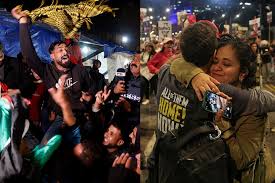
Finally, the war in Gaza (for some a slaughter, for others genocide) has stopped; we can only all be happy about it.
Trump's plan received almost universal approval: first and foremost from all Arab and Islamic governments, from Europe, including Russia, China, and other countries. Such unanimity is rarely recalled in history; however, it is also true that the contenders, Israel and Hamas, would not have wanted it and were forced to accept it by their own allies or potential allies.
It is only an agreement, in practice a truce and not a peace. A prospect of peace is also presented within it, but it appears distant. The points of the agreement are quite vague, uncertain, and susceptible to different and opposing interpretations. We do not know, then, whether it is only a truce, perhaps a short one, or actually a path that will lead, in certainly not short times, to the solution of the Arab-Israeli conflict that has lasted for almost 80 years.
In our opinion, the outcome will depend less on the points of the agreement and more on the effect that these two terrible years of war have had on the two peoples involved, especially in Gaza.
It should be noted that the Arab-Israeli conflicts from 1948 to 2023 had caused a limited number of victims compared to other Middle Eastern conflicts. It is estimated that in the 30 years preceding 2023, there were 10,000 Palestinian and 2,000 Israeli casualties. Consider the estimated 400,000 deaths in 10 years in the conflict between Saudi Arabia and the Houthis, which was then ignored by both the West and the M.E. (Middle East).
It is difficult, however, to predict the effects, both in Israel and in Gaza.
In Israel
Israel is a country with a parliamentary democracy based on the Western model, so it is quite easy to understand what citizens think simply by observing election results. It should be noted that the electoral system is proportional (like in Italy) and there is a myriad of parties that sometimes unite for elections.
However, in this case, we can only consider their attitude towards relations with the Palestinians.
Let's look at the results of the last elections in 2022.
The parties we define as the Messianic Right (ultra-Orthodox) amounted to approximately 23%. For them, all of Palestine belongs to the Jews by divine will (the Promised Land), and leaving even a strip of it to others would be sacrilegious.
These groups appear to be a mirror image of the Islamic extremists, also obsessed with sex (women must have a separate space on public transport), with the idea of being God's chosen people, who one day will guide the whole world.
Some say that Israel is moving from a European culture to becoming a Middle Eastern country. I don't know; after all, the majority continues to maintain a Western mentality.
The right-wing but secular party (Likud) was around 23%: it is against the two-state solution, not for religious reasons, but because it fears what already happened in Gaza: once the Israelis withdrew, it became a base for continuous attacks on Israel, entirely focused on the dream of annihilation. However, it is of Western culture; for example, Netanyahu, of Polish origin, studied and lived for a long time in America.
The center and left-wing parties reached 38% (to which the approximately 5% of the Arab lists could be added), which are more open to an accommodation with the Palestinians.
What influence has the Gaza conflict had? The isolation in which the Israelis found themselves at a certain point could push them towards greater flexibility, to reject certain excesses. Ultimately, Israel can only survive with American help.
But it could also happen that the events of these two years push the country towards an even harsher and more intransigent position: the idea of US OR THEM prevails: that is, we can only survive if either we or they do. Therefore, if we want to avoid a second Shoah, all that remains is the annexation of the rest of Palestine with ethnic cleansing or worse.
In Gaza
The West generally considers HAMAS a terrorist group like the Red Brigades: but the Red Brigades had no following, no power; they were just a small group of fanatics who deluded themselves into starting a revolution. If they had ever run in elections, they wouldn't have even reached the minimum threshold for representation.
Instead, HAMAS has governed Gaza for many years uncontested; it is unreservedly supported by the population who applauded them as heroes for October 7th.
HAMAS represents Gaza, it is Gaza, and not only that, but it also represents a significant part of the Arab world that sees the destruction of Israel as the premise for the Islamic revival.
It is the same relationship that Nazism had with Germany in the 1940s: the German army fought with exceptional ferocity.
Under these terrible conditions, the population of Gaza has not rebelled against HAMAS at all: they could have easily driven them out, just as HAMAS could have stopped the whole slaughter simply by withdrawing from Gaza—they didn't even need to surrender.
It is not a matter of fighting HAMAS but an entire mentality that considers this war the struggle of believers against unbelievers—that is, of good against evil, the fight against the great and the small Satans.
Unlike Israel, we don't know much about what the Palestinians, especially those in Gaza, really think. In reality, over these two years, we have had an endless stream of images of ruin and death, which cannot be doubted, but we know nothing precise about what happened in Gaza.
The death toll is the one reported by HAMAS, which, however, has not told us how many of them were HAMAS militants (comparable to soldiers) and how many were civilians. If we consider the immense destruction, the number of casualties provided by HAMAS seems limited. For example, consider that in the bombing of Tokyo in 1945, 75,000 civilians (generally burned alive) died in a single air raid—more than the casualties caused over two years that razed the entire Gaza Strip.
Crucially, we do not know what interests us now for predicting the evolution of the situation: what effect has this horror had on the population?
It could be that the Gazans will continue to support HAMAS as they have done for the last 20 years, and that, on the contrary, as is generally said, the hatred and the desire to destroy Israel have grown even more for the next generations.
But it could also happen what occurred in 1945: faced with the immense destruction suffered, the nationalist follies of Japan and Germany were extinguished, and definitively so.
Perhaps the Gazans too will have been convinced of what is clear to everyone else: that trying to destroy Israel leads only to catastrophes (Nakba, as they call it) and that an omnipotent and merciful God does not help them at all.
An essential point is that the Americans offered a generous peace. Will Israel ever do such a thing?
Unfortunately, I don't think so.