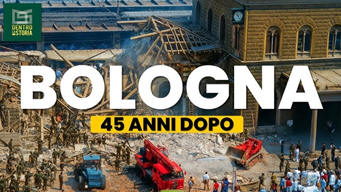
This year marks the 45th anniversary of the Bologna bombing, the attack that caused the largest number of victims in our recent history and, as far as can be recalled, in the past as well.
For 45 years, all speakers and mass media have been repeating that it was the work of fascist terrorism, with the support of the secret services, Licio Gelli's P2 lodge, and above all, obscure political connivance linked to the "strategy of tension."
No one seems to doubt the convicted neo-fascists, as the sentences are now final. It is hoped, and competent authorities—the judiciary—are urged, to uncover the masterminds and the shadowy instigators of that terrible massacre.
Was it the Masonic P2 lodge, rogue secret services, and political connivance that planted that bomb and many others as part of the strategy of tension? Do we truly have such certainty about the masterminds and perpetrators?
Let's do a simple thought experiment. It's enough to reflect a little on the inconsistency of any possible political motive to realize that there could be no intricate political plot, but only the actions of reckless people who have lost touch with reality, if not a mere fortuitous incident.
Let's look at the facts from a substantial point of view, without going into detail.
The fundamental problem is that the purpose of that massacre is not understood at all. The idea that it was aimed at a dictatorial coup (say, a fascist one) is completely out of the question: why would it have been? It would clearly have been attributed to neo-fascists, as indeed it was. We speak of an attempt at destabilization, but what does destabilization mean? Would people, in the face of a fierce attack attributed to fascists, have supported a fascist coup? Or would they have risen up against democracy? Or other such things? These seem like obvious nonsense to me.
In a purely theoretical sense, could the goal have been to provoke a communist revolution in reaction, or more modestly, a shift of the electorate to the left? But who would ever believe such nonsense?
Therefore, lacking a rational purpose, it was the work of right-wing, left-wing, or center-wing extremists, or a simple madman, or just a fortuitous explosion of material brought by Palestinians, Israelis, Americans, or Martians.
All the hypotheses formulated—and we could make hundreds of them—are just fantasies that have no basis.
Therefore, WE DO NOT KNOW. This seems to be the obvious truth.
However, there is an appeal to judicial truth, but one must not confuse judicial truth with truth itself. Let's set aside the reliability of Italian and foreign judiciaries, but error is always possible. For example, in the case of Ilaria Alpi, a poor Somali man ended up with a life sentence based on the testimony of a fellow countryman who later retracted it (not even in court), and he was then freed.
It would be a strange idea for historical truth to coincide with legal truth: for example, were the victims of the Stalinist purges truly guilty of treason? We could use the example of Pimentel Fonseca or even of Jesus.
From a historical point of view, sentences must be evaluated in the climate in which they were issued, considering the reliability of the evidence on which they are based. It would not be possible here to review all the sentences with the thousands of pages that justify them. Let's limit ourselves to a few examples.
Regarding Mambro and Fioravanti: they proudly admitted to all the crimes they were accused of, almost as a merit, but they always rejected any involvement in the Bologna events. The first court of appeal acquitted them.
The judges relied on the testimony of a certain Sparti, who was, however, contradicted by his family and later even retracted his statement: does this seem like reliable testimony? Certainly not. Furthermore, Sparti's testimony consisted only of having seen Mambro and Fioravanti, and his claim that they carried out the attack was merely his supposition.
Are life sentences given on such vague evidence?
Bellini: he was supposedly present, but only based on a photo that his wife, who was on bad terms with him, recognized 40 years later, and from an expert who claims to be certain, despite other evidence that places him somewhere else at that time. Does this seem like reliable testimony to you? It doesn't to me.
But even assuming that Bellini was at the station, this does not mean that he helped the other two in the attack. He might have denied it simply to avoid being charged, as indeed happened.
I am not claiming that the convicted individuals were not guilty, but only that there is no evidence that has a minimum of credibility. It may all be true, but WE DO NOT KNOW.
The statement that a lie repeated a thousand times becomes a truth is attributed to Goebbels (but this is not accurate). In the same way, by repeating it relentlessly, even German civilians became convinced that Jews were sub-humans, yet it was so simple to realize that this was nonsense.
Thus, after 45 years of repeating these fantasies, these baseless assumptions, these inconclusive arguments, they have become absolute truths. And anyone who questions them seems like a heretic, a moral accomplice, and is pointed to with contempt by everyone. But in reality, it is enough to consider that the attack could not have had any of the purposes attributed to fine and astute minds, as the conspiracy theorists would have it.