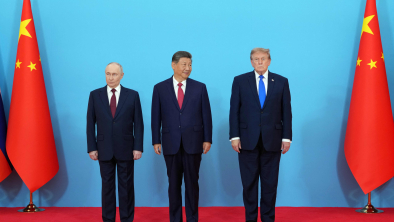
Shenzhen: An Assertion of China's Power
Pubblicato da In dies Info 23 novembre 2026
The meeting in Shenzhen attracted worldwide attention and was described as historic, the beginning of a new era. In reality, we do not know whether it will eventually be regarded as a historical turning point or whether it will prove irrelevant and be forgotten.
What we can observe for the moment is, above all, an assertion of China's position under Xi Jinping.
Indeed, Xi placed himself at the centre of the international stage, welcoming the representatives of the other two world powers with remarkable courtesy and assuming the role of an arbiter. China appeared not merely as an economic power, but also as an indispensable international interlocutor. This is the result of a carefully planned foreign policy, under which China has avoided becoming involved in local disputes and wars. It has kept its distance because it does not intervene to promote its own ideology or political supremacy, but instead assumes a fundamental role in reshaping the world order as a whole.
The location of the meeting also seems particularly appropriate: in just a few decades, Shenzhen has grown from a humble fishing village of 30,000 inhabitants into a metropolis of 13 million, one of the world's leading centres of technological development, competing with America's Silicon Valley.
Putin, too, gains a considerable image advantage from the meeting. Russia regains the status of a major world power that it had lost with the end of the USSR. It is no longer confined to the role of a regional power, as the Americans and Europeans had relegated it to. I doubt, however, that Russia is actually capable of playing such a role, but that is another matter. Above all, Putin emerges from the isolation in which the West wanted to confine him: he is no longer treated as a war criminal, but as one of the three great leaders of the world.
Trump, as usual, presents the meeting as a personal success, something he desperately needs after the serious defeat in the midterm elections. In reality, however, the United States loses at Shenzhen the position of global hegemonic power it had assumed following the collapse of the USSR. It is no longer the guardian, the policeman of the international order, that it had been for the past forty years.
Europe is the one that emerges marginalised from the world stage, despite its economic and civilisational weight. The problem is that it does not exist as a state, but is merely an association of 27 states, each with its own priorities and interests, and without a unified global foreign policy. Furthermore, the advance of right-wing forces on the one hand and economic and social discontent on the other, expressed through large-scale protest demonstrations, make the future of European politics highly uncertain. For example, although all governments currently declare their solidarity with Ukraine and their support for helping it, most voters appear very uncertain on this issue. Consequently, it is impossible to know what political direction Europe will take in the coming years.
Above all, however, the greatest losers are the supranational institutions established at the end of the Second World War: the United Nations, the Court of Justice and similar bodies, which the final communiqué describes as needing reform. But in what sense? This seems more like a euphemism for saying that they should be replaced. In reality, it appears to be little more than an acknowledgement of their inability to play a genuinely effective role. It is difficult to recall any conflict that has actually been resolved by the UN, just as the verdicts of international courts have had no real effect until after the complete defeat of those under investigation. For example, Mladić's conviction came after Serbia had been brought to its knees by NATO (certainly not by the UN), and after his death he was widely honoured by his compatriots.
The most important point, however, in my opinion, is that the idea of fighting authoritarianism in order to promote rights and democracy has been abandoned. We Europeans believe that these principles are right and natural and should therefore be extended throughout the world. In reality, civilisations and sociocultural contexts are different and often conflicting. It is therefore by no means true that our principles are natural and universal, or self-evident, as the American Declaration of Independence put it.
Shenzhen has been compared by many to Yalta, but I find the comparison inappropriate. At Yalta, the victorious powers met to prevent a third world war from following the tragic Second World War. Essentially, the conference recognised the situation that had emerged in Europe. The Communist parties of Western Europe abandoned their revolutionary ambitions, postponing them indefinitely, and accepted so-called "bourgeois" democracy. The Western powers, for their part, were careful not to intervene in the repression carried out by communist regimes in Germany, Poland, Hungary and later Czechoslovakia. Nevertheless, the Cold War continued elsewhere in the world, and its victims numbered in the millions.
By contrast, it is important to point out that nothing concrete was decided in Shenzhen; no agreements were reached. The wars in Ukraine and the Middle East continue as before, no trade agreements were concluded, and the final declarations concerning peace, cooperation and reform of international institutions remain vague.
It may nevertheless prove to be a turning point, one that will lead to developments in the future and shape a new world order. But it may also have been nothing more than an illusion, without any real consequences.
We should also bear in mind that while Russia and China have governing policies that are likely to remain stable in the coming years, especially in China's case, Trump's presidency in America will end in two years and he cannot be re-elected. The Congress emerging from the midterm elections is clearly opposed to Trump. Europe, the great absentee, also has considerable weight, and we do not even know what its political direction will be after the next elections.
Only the future will tell us whether, and to what extent, this meeting was truly significant.