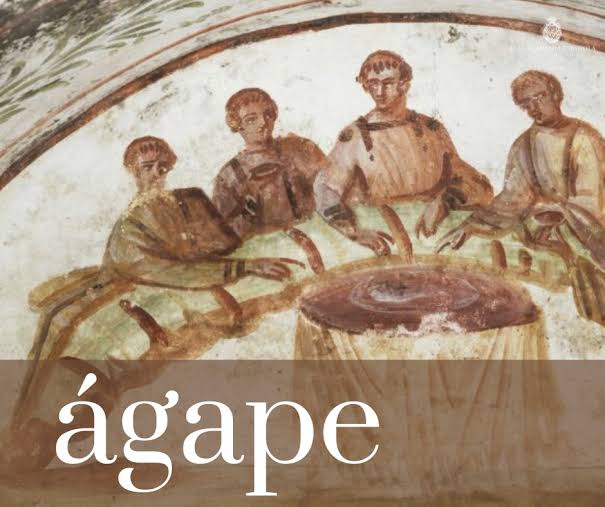
The term agape was used by the early Christians to indicate the core, the fundamental pillar of the Christian faith. The term has no exact equivalent in our language or, generally speaking, in other European languages. We translate it as “love,” but this word can refer to many different and even contradictory things. We speak of the “love of God” just as we speak of “romantic love”; it can also refer to family affection, or to a preference for a particular thing (love of science, of art) or for certain people (pro-Putin sympathies), and many other things.
In classical Greek, however, there are at least four different terms. Eros refers to romantic love (the origin of the English word “erotic”); philia refers to friendship or affinity (as in “pro-American” or “philosophy,” meaning a love of knowledge); storge refers to family affection (with no corresponding derivative in Italian). There is also the term agape, which denotes a disinterested, altruistic love that seeks to promote the well-being of others.
As we have said, the term agape was therefore adopted by the early Christians to express what we may consider the central point of the Gospel message: love for one's neighbour, who may in fact be someone very far removed from us, expressed through an ethically motivated act towards another person, without expecting anything in return.
There does not seem to be a corresponding term in Hebrew. In Latin, it was translated as caritas (not amor), because this word could, in some way, though not with complete precision, convey the meaning of the Greek term. In Italian, it was rendered as carità (charity). Over time, however, this word came to mean the alms given to those in need and was therefore eventually replaced by the term “love,” which nevertheless remains ambiguous.
The concept expressed by the term caritas was the subject of a famous letter by Saint Paul (First Epistle to the Corinthians, 13). In it, he clarifies the concept, considering this virtue the most important of all. Even if we knew all languages, without charity we would say nothing more than the meaningless sound of a cymbal or a gong. And even if we gave everything we possessed to others, without charity it would be worth nothing. And when everything else has come to an end, charity will still remain.
Charity can be defined as the virtue repeatedly invoked by Christ and, I would say, particularly in the account of the Last Judgment reported by Matthew: “For I was hungry and you gave me something to eat, I was thirsty and you gave me something to drink, I was a stranger and you welcomed me, I was naked and you clothed me, I was sick and you visited me, I was in prison and you came to visit me. Truly I tell you, whatever you did for one of the least of these brothers and sisters of mine, you did for me.”
This principle has shaped our entire civilization over time. Ultimately, all the currents of thought in the West, even those opposed to and hostile towards the Church, which promote atheism in opposition to Christianity and every other religion, are nevertheless driven by the principle of agape. Communism, for example, also sought to create a world in which caritas would triumph (“From each according to his ability, to each according to his needs”).
The same concept also underlies the Enlightenment, which advocates the equality of all human beings, and it is likewise at the foundation of democracy and the welfare state.
Today, wherever in the world there are hungry people, the sick, or victims of terrible wars, we still find Western organizations, both religious and secular, ready to provide assistance, driven by what Christians called agape.
Indeed, I do not see any organizations formed by Chinese, Indians or Arabs that devote themselves to caring for the most disadvantaged people in the world. Only the West is driven by brotherly agape in coming to the aid of the most vulnerable people on Earth, wherever they may be and whoever they are.