The Powerful and the Masses
Pubblicato da : res publica : quaderni europei: settembre 2026
In ancient historiography, great events were attributed to great men; in modern historiography, however, great events are attributed to great social causes.
This change began in the nineteenth century and became established in the last century, starting with the Nouvelle Histoire and the histoire de longue durée.
To give an example: in the past it was said that Caesar founded the Empire, that Constantine transformed it into a Christian empire, that Charlemagne revived it with the Holy Roman Empire, and so on. Today, instead, we think that these figures carried out what great historical forces required.
Indeed, the ancient Roman republican order, which had arisen to govern a city, was not suited to governing a vast empire, practically the entire known civilized world of the time. Thus Rome sank into long-lasting civil wars: Marius and Sulla, Caesar and Pompey, Octavian and Antony. Therefore Caesar Augustus, in creating the institutions of the Empire, implemented political necessities that had by then become unavoidable. We may therefore say that the Roman Empire did not exist because Octavian decided so, but because deep causes involving all populations required it. Augustus merely carried out those necessities in a particularly effective way.
Likewise, it is said that Constantine (and later Theodosius) transformed the Roman Empire from pagan to Christian. But such a transformation was certainly not due to a personal decision by Constantine; rather, it resulted from the spread of Christianity after centuries of persecutions, all of which had proved useless, because pagan religiosity increasingly appeared inadequate, while Christianity became more and more widespread. The blood of the martyrs became the seed of new Christians, as Tertullian observed.
Indeed, it was not only Constantine who recognized the predominance of Christianity; his rival Maxentius had done so as well, just as Christian states were beginning to emerge in the East, such as that of the Armenians.
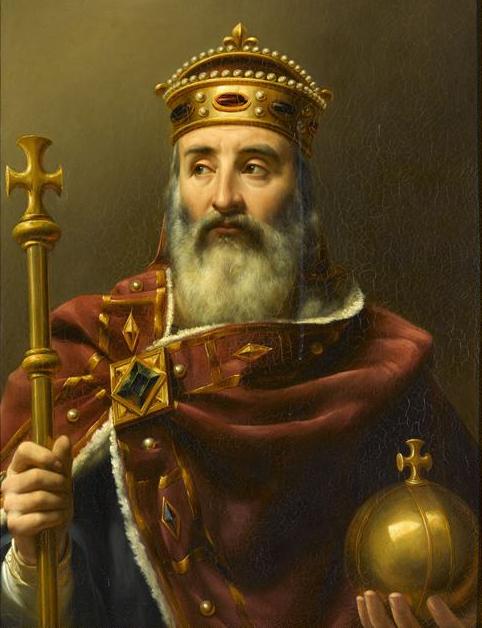
Similarly, Charlemagne founded the Holy Roman Empire (or perhaps it would be more accurate to say Pope Leo did), which lasted a thousand years, until Napoleon abolished it without the Congress of Vienna restoring it.
In reality, the effective power of the Empire lasted only until Charlemagne’s death. What remained during the following thousand years was the idea that Europe, though divided into many states, feudal domains, and local principalities of every kind, nevertheless recognized itself in a single cultural entity, which even adopted a single official language, Latin, although in practice countless dialects and subdialects were spoken. The consciousness of European Christian unity (that of the Empire) had established itself precisely because the barbarian peoples who invaded the Roman Empire could only recognize the superiority of Latin civilization, whose language was later adopted by the Church.
Charlemagne provided the occasion for such an identification among peoples to be recognized.
Let us now move to more recent history: fascism and communism.
They were the result of their historical moment. The proof is that if Hitler were to repeat his speeches today, he would be drowned in ridicule, whereas at that time an entire people, one of the most advanced in the world, followed him to ultimate catastrophe. Indeed, Nazism and fascism spread throughout Europe and even found sympathy in England and France, which later fought against them. A similar movement, though within a different culture, also established itself in Japan, the most advanced country in Asia.
Now, if we turn to the USSR, Stalinist repression did not depend solely on Stalin’s cruelty (which was indeed great), but also on deep historical causes. After the communist revolution had triumphed, it attempted to establish Marxist communism, but the system did not work. The choice then was either to abandon that dream as unrealizable or to insist through violence and repression, believing that in this way true communism would eventually create the world of happiness promised by Marx—in short, a necessary sacrifice. The second path was attempted, with increasingly ferocious repression, generally accepted as necessary even by our own intellectuals.
Then, after Stalin’s death, the system moved toward what we call “real socialism”: true communism was postponed to an indefinite future, while the system, although unable to achieve the prosperity of the West, nevertheless had some positive aspects.
In conclusion, what moves history are deep causes, cultures (in the sociological sense of collective mentalities) that establish themselves at a given historical moment for various and complex reasons. The decisions of political leaders (whether dictators or democrats) depend upon conformity with those dominant cultures. It is true, however, that the manner in which such ideas are implemented depends greatly on how they are managed by political leaders.
If we now have a conflict in the Middle East, we cannot say that this depends simply on the fact that Netanyahu seeks to avoid a criminal trial, that Trump is out of his mind, that the Ayatollahs are fanatics, or that they merely wish to maintain power. The causes are that large Islamic masses see in Israel the vanguard of the unbelievers by whom they feel threatened; that Israeli masses fear being overwhelmed by the immense Arab populations; and that America (like the entire West) feels that it cannot allow a second Shoah.
Certainly, the fact that at this moment the situation is being managed by Netanyahu, Trump, and the Ayatollahs is important and may have a decisive influence on the course of events, though they are not the ultimate cause of them.