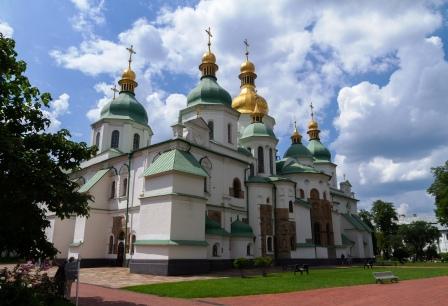
The Russian Church in Ukraine
Last year the parliament in Ukraine banned the Russian Church, but the issue attracted little interest in the West, partly because people did not really understand what it was about. What drew much more attention was the firm and forceful opposition of the Pope, who declared that churches must not be touched and that everyone must have the right to pray as and where they wish, according to their own conscience.
Let us therefore try to shed some light on the matter, starting with a brief historical overview.
The first state entity of Christian Slavs was, around 800 A.D., the Principality of Kiev, founded by the Rus, a group of Vikings known here as Varangians. Having been converted by Greek missionaries (Cyril and Methodius being the most renowned), they followed the Greek rite (what we call Orthodox).
However, when the Greek Church definitively split from the Latin Church (the East–West Schism in 1054), Christians of the Greek rite formed autocephalous churches (what we call Orthodox): each people (or rather, each state) had its own independent church, whereas the Catholic Church (meaning “universal”) acknowledged the authority of the successor of Peter, the Roman Pontiff. This meant that each national church relied on and aligned itself with the state (somewhat like the Lutherans), dealing only with strictly religious and liturgical matters, while the Catholic Church embraced all nations and states and therefore did not take sides in internal conflicts among Catholic nations. Moreover, it concerned itself deeply—some say too deeply—with social issues.
The Principality of Kiev first weakened due to internal conflicts, but was above all completely overwhelmed around 1200 by the invasions of Genghis Khan’s Mongols and remained subject for centuries to their successors, Islamic populations originally from Central Asia, known here as Tatars (we say Tartars), who still live in Russia today.
Meanwhile, other Slavs had been converted by Germanic and Latin missionaries and had thus become Catholics (Czechs, Slovaks, Croats) and, of more interest to us, Poles and Lithuanians, who in the 1600s were united and occupied Ukraine, which became a battleground among them, the Muslim Tatars, and the Orthodox Principality of Moscow (which called itself the Third Rome).
At a certain point Khmelnytsky, an ataman of the Cossacks (Ukrainian brotherhoods of professional soldiers), sought help from his co-religionists in Moscow against the Polish Catholics and, gradually and with alternating fortunes, the Ukrainians entered the emerging Russian Empire and accepted the Russian Orthodox Church, led by the Patriarchate of Moscow.
Part of Ukraine, however—what we call Galicia (not to be confused with the Spanish one), called Halychyna in Ukrainian (the present-day Lviv oblast)—remained with Poland, and the local church accepted union with Catholicism while preserving the Orthodox rites it had always followed (the Greek Catholic or Uniate Church). In the 1700s, with the partition of Poland, Galicia became part of the Habsburg Empire, also Catholic, and after 1918 it returned to Poland, later reuniting with the rest of Ukraine and then with the USSR at the end of the Second World War. The Greek Catholic Church was particularly persecuted by Stalin and later by his successors because it was seen as linked to Catholicism, the enemy of communism.
With the final collapse of communism, religious freedom returned. However, since Orthodox churches are autocephalous (that is, national), a Ukrainian Orthodox Church was formed with no further ties to Moscow. Nonetheless, the Russophone part of Ukraine (about a quarter of the population) continued to belong to the Church of the Moscow Patriarchate. Ukraine thus has four Christian churches: the Ukrainian Orthodox Church, the Russian Orthodox Church, the Greek-rite Catholic Church, and also the Latin-rite Catholic Church for the few remaining Polish residents.
With the outbreak of the current Russo-Ukrainian war, rifts emerged among the churches. The Uniate Catholic Church, while locally sharing Ukrainian claims, found itself embarrassed because the Pope, from the very beginning, prioritized the pursuit of peace over nationalist demands. The Ukrainian Orthodox Church supports the government unconditionally, as is Orthodox tradition.
The Russian Church, on the other hand, has found itself in great difficulty because the Patriarch of Moscow, Kirill, in turn unconditionally supports Putin. For this reason, from the very start of the war, members of the Russian Church clergy were viewed with suspicion and sometimes arrested for treason. After the invasion began, in the spring of 2022, the Russian Church in Ukraine declared itself autonomous from Moscow, and all references to the Moscow Patriarchate were removed, including the name of Patriarch Kirill in the prayers, as had been customary. However, this was not enough. After a year and a half of tensions and setbacks, the Ukrainian Parliament approved new regulations banning any “religious organization subordinate to those of the aggressor state.” The Russian Church in Ukraine is not explicitly mentioned, but the meaning is clear and unmistakable: President Zelensky states that the law aims to defend national security and strengthen the country’s spiritual independence.
In short, the last thing one could hope for is yet another religious conflict, which for centuries has bloodied those lands. We Westerners now strongly support complete religious freedom, and this regulation is certainly not welcome to us because it contradicts the idea of a democratic Ukraine fighting against Russia’s absolutism.
On the other hand, there are no doctrinal or even ethical-cultural differences to speak of. For example, if the Patriarch of Moscow, Kirill, describes the war in Ukraine as a sort of crusade against the decadence of the West—supposedly dominated by LGBT ideology—then even the patriarch of the autocephalous Ukrainian Church of Kiev, Filaret, some years ago described Covid as a divine punishment for the acceptance of LGBT people.
The concept of ethical-scientific research requires some clarification. One might rightly object that, in fact, the two terms are contradictory. Science and ethics have fundamentally different objects and methods. Science, in fact, addresses the question of “how reality actually is” and not of “how it should be,” whereas ethics, on the other hand, aims to indicate how the world ought to be, not “how it is.”
For example, a doctor is concerned with whether a patient is affected by a certain syndrome and does not question whether this is right or wrong. In ethics, however, the occurrence of an event does not indicate whether it is permissible: even if many, or even all, people steal, this does not mean that stealing is good. Indeed, we can say that we are all imperfect; in the Christian sense, we acknowledge and are all sinners—but this does not mean that sin ceases to be sin, nor that one should not struggle against it.
Science and ethics, therefore, have different natures and seem irreducible to one another. So, what is the point of talking about the ethics of scientific research? First of all, it must be clarified that ethics does not aim to set limits on science: it is obviously not about rejecting scientific conclusions that are or seem to be in conflict with ethical demands. It is always a serious logical error to confuse “what is” with “what ought to be.” Otherwise, we risk repeating cases like that of Galileo, which had such a negative impact on faith and on the Church.
We are talking about “scientific research,” not “scientific conclusions.” Let us consider some examples.
It is said that Emperor Frederick II of Swabia ordered that certain children be raised without anyone ever speaking to them, to see which language they would use. It is reported that the children all died and the experiment produced no results. Apart from the fact that the story is almost certainly legendary, it is clear to everyone that experiments of this kind cannot be conducted for ethical reasons.
Moving to unfortunately real events, Nazi concentration camps conducted medical-scientific experiments on prisoners: everyone is horrified by this, and those who carried them out are unworthy of being called scientists, doctors, or even human beings.
Indeed, no one doubts that children or prisoners cannot be used as experimental subjects, as Frederick II and the Nazi doctors did: human natural rights are such that even scientific research must yield.
It is therefore clear to everyone that scientific research (not scientific knowledge) must have limits: this seems absolutely peaceful and self-evident. So why so much discussion, and often acrimony, particularly toward the warnings of the Catholic Church, and even accusations of obscurantism?
The problem is that the new frontiers of biomedical sciences pose new ethical problems, which find no precedent in the established ethical tradition. In particular, the fundamental question is: when does a human being become a human being? At conception, at birth, or at some intermediate stage? And, therefore, is it permissible to manipulate fertilized eggs, fetuses, or unborn children? These are serious issues that affect the very foundation of every civilization’s values: the value of human life itself.
From this perspective, scientific research must take ethics into account. As the Church rightly asserts and teaches, one cannot act based on a supposedly abstract principle of freedom of research: every freedom is truly concrete when it meets its limit.
Another problem concerns the use that can be made of scientific discoveries: is it permissible, for example, to choose the sex or physical and psychological traits of one’s child? But here the issue is no longer research itself, but the use of science; we will discuss this another time.