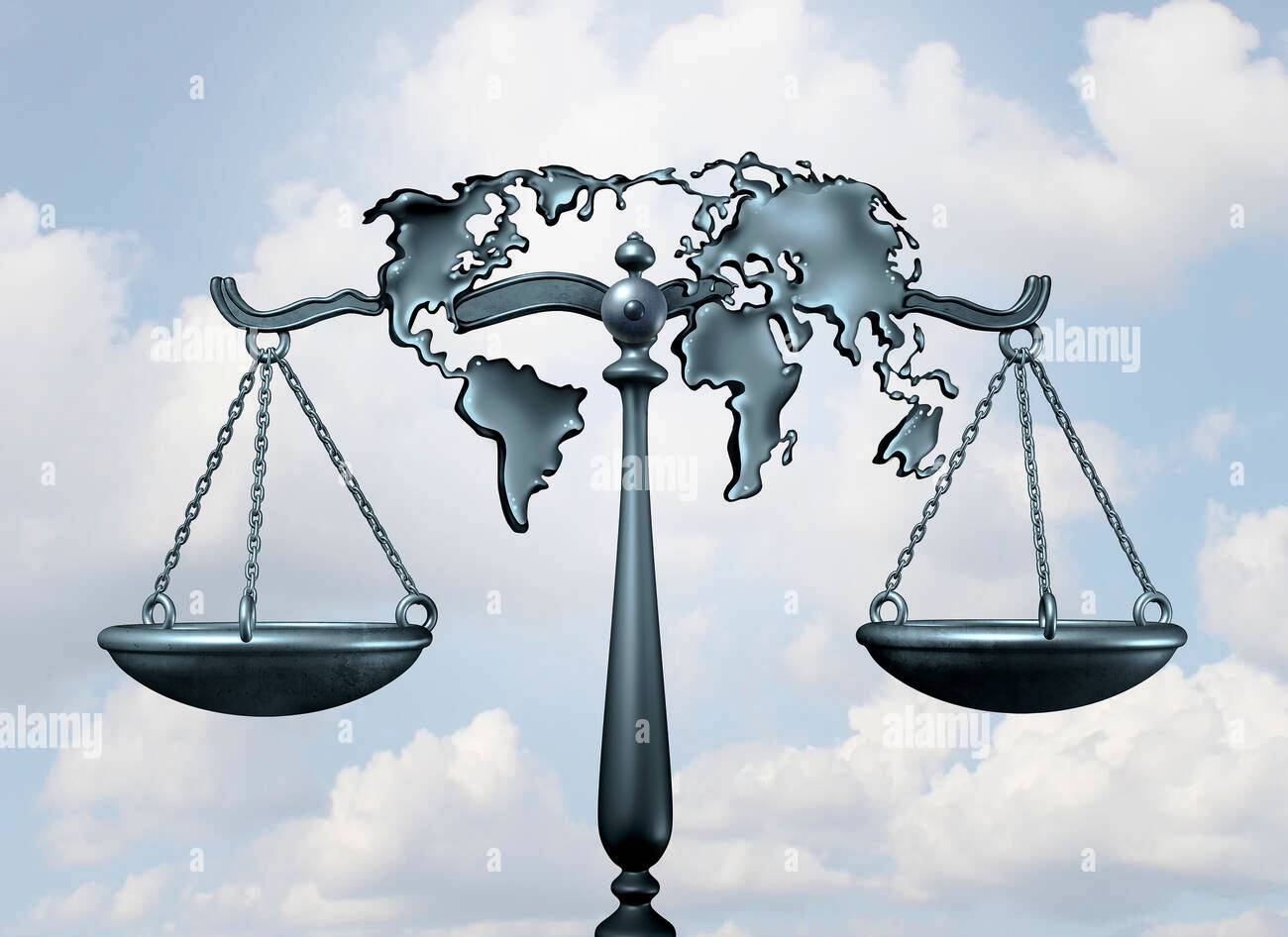
The Strength of Law and the Law of Strength
The contrast between "the strength of law" and "the law of strength" has its roots in the Enlightenment and assumes that the former should prevail over the latter. This concept is often invoked during times of conflict, such as the current situations in Ukraine and Palestine. While this may seem self-evident, a deeper analysis reveals that in the international context, the reality is often the opposite: force prevails over law. This occurs because there are profound reasons why a principle that seems indisputable in theory clashes with a very different reality in practice.
To fully understand the problem, it's essential to distinguish the application of these concepts in domestic law versus international law.
On the Domestic Level
Within a state, there is codified law, one of the three elements that characterize it. Laws are enacted by an authority (sovereign, parliament, autocrat) and generally reflect the culture of the people they apply to. In the past, law wasn't even codified; it was based on customs and traditions. It was only with the French Revolution and the birth of the modern state that the need to codify norms emerged to protect citizens from the arbitrary actions of authority.
The enactment of laws is followed by the force of the state, which, through police and prisons, punishes those who break them. Citizens have no way to oppose this force. However, most people respect the laws not out of fear of punishment, but because the norms reflect shared principles. For example, most people recognize that serious crimes like femicide are unacceptable, and those who commit them represent a very small percentage of the population.
Despite this general acceptance, domestic law faces challenges. The opinions of citizens are diverse, and force is not always sufficient or appropriate. Nevertheless, in "normal" times, these divisions remain within a common cultural framework. In contrast, during moments of crisis, such as revolutions or civil wars, society fractures, and shared law disappears. In these cases, the winner of the conflict imposes their own principles: it is force that creates a new law.
On the International Level
At the international level, the situation is radically different. If bloody conflicts erupt, it means that the parties have fundamentally opposing conceptions of law and values.
Take, for example, the conflict in Palestine. For the Islamic fundamentalists of Hamas, Palestine was entrusted by God to believers, and to leave even a small part of it to non-believers would be blasphemous. Similarly, for fundamentalist Jews (Haredim), God promised the entire land of Israel to the chosen people. The Western world, on the other hand, supports a two-state solution. In this context, does it make sense to talk about law if each contender has a completely different idea of it?
The same can be said for the conflict between Russia and Ukraine, where Russians consider NATO a threat to their existence, while Ukrainians and Westerners see the Russians as invaders. Similar situations have occurred in the Cold War, the Italian Risorgimento, and the Wars of Religion. In these cases, there is no shared law among the parties.
Furthermore, the force to impose law is absent. Organizations like the UN lack the coercive power to stop those who violate their decisions. Unlike within a state, there is no international entity with a "police force" or "judicial system" capable of enforcing its decisions.
Conclusion
In conclusion, while within a state, in normal times, the strength of law prevails (albeit with its limits), at the international level, one cannot speak of either a universally recognized law or a force capable of enforcing it.
Often, those with more force are able to impose their own concept of law, but even this doesn't always happen. International dynamics remain complex and, unfortunately, the "law of strength" too often prevails over the "strength of law."